Reviewed and last updated on August 29, 2026 by Awais Ahmed, Founder & Editor-in-Chief, Urban Scope News.
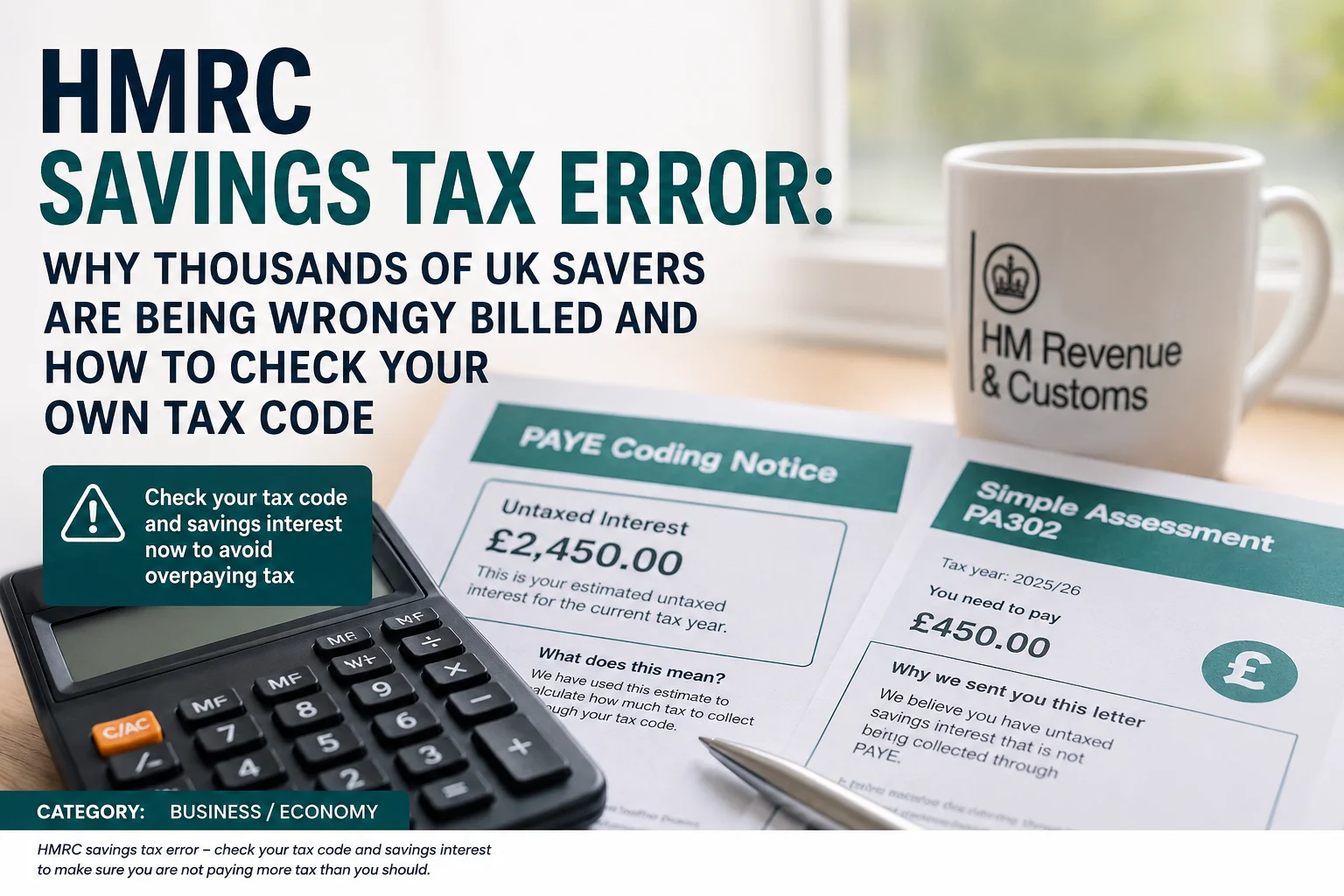
Reports of an HMRC savings tax error have caused concern among UK savers after some people received unexpected PAYE tax-code changes or tax bills linked to savings interest.
An unexpected change to your PAYE tax code can be worrying, especially when HMRC says you have earned savings interest that you do not recognise.
Reports during 2025 and 2026 have highlighted cases where savers have faced incorrect or unexpectedly high tax charges linked to savings interest. Problems reported have included tax-free Cash ISA interest appearing as taxable income, inaccurate estimates of future savings interest and difficulties matching information supplied by banks and building societies with individual taxpayers.
However, this does not mean that HMRC’s entire savings-tax system is faulty. HMRC has said that only a small number of data-matching cases result in mismatches and that matching rates have improved. The more important message for savers is simple: do not assume the savings-interest figure shown by HMRC is automatically correct. Check it against your own records.
What is the HMRC savings tax error?
Banks and building societies provide HMRC with information about interest paid to customers. HMRC uses savings information together with details about your other income to determine whether tax is due.
For employees and pensioners, HMRC can collect savings tax by changing a PAYE tax code. For tax that cannot be collected through PAYE, HMRC may issue a Simple Assessment, formally known as a PA302.
There is another important part of the process that can create confusion.
For the current tax year, HMRC does not necessarily know exactly how much interest you will eventually receive. GOV.UK explains that HMRC may estimate the current year’s savings interest using the amount received in the previous year.
That means an amount described as “untaxed interest” in your tax code can sometimes be an estimate rather than an exact total supplied by your bank for the current year.
This distinction matters when investigating a suspected HMRC savings tax error.
What has actually gone wrong?
There is no single error affecting every saver. Several different problems can produce an incorrect or unexpected savings-tax calculation.
Tax-free ISA interest appearing as taxable
Interest earned within a valid Cash ISA is normally tax-free and does not count towards your Personal Savings Allowance.
Media reports have documented cases involving Zopa customers where Cash ISA interest was reportedly supplied or processed as taxable savings interest. Zopa was reported to have corrected the relevant information, although some affected customers continued to experience incorrect HMRC calculations or tax-code changes.
This appears to have been a specific reporting/data-processing problem rather than a change to ISA tax rules.
HMRC estimates can be much higher than actual interest
HMRC can use previous savings information to estimate the interest you are likely to receive during the current tax year.
That works reasonably well when your savings balance and interest rate remain similar. It can produce a misleading result if you have moved or withdrawn savings, closed an account, transferred money into an ISA or experienced a major change in interest earned.
A May 2026 report citing a Telegraph investigation described one taxpayer whose untaxed savings interest was estimated at £3,847, although the actual amount was reported to be just £94. The incorrect calculation was said to have resulted in a projected £1,476 tax overpayment and temporarily reduced monthly take-home pay by around £200 before the tax position was corrected.
The individual case has been widely reported but should be viewed as a reported example rather than evidence that the same error is affecting every saver.
Data-matching problems can occur
HMRC receives large quantities of information from banks and other institutions and must match that information to the correct taxpayer.
In a parliamentary answer published on 29 June 2026, the Treasury said HMRC was not aware of a general discrepancy between the savings information institutions provide to HMRC and the information they provide to their customers.
However, it acknowledged challenges in matching financial-institution data with HMRC records. It said matching rates had improved from around 70% to around 85% and that a small number of mismatches could still occur.
That distinction is important. A tax-code problem does not necessarily mean your bank supplied the wrong interest figure.
Joint accounts can cause confusion
GOV.UK states that interest from a joint account is normally split equally between the account holders for tax purposes.
For example, if a two-person joint savings account earns £2,000 in interest, the normal starting assumption is £1,000 for each account holder.
If the beneficial ownership of the money means the interest should be divided differently, HMRC says taxpayers should contact it.
This makes joint accounts another area worth checking if the savings figure appearing in your tax calculation looks unfamiliar.
How much savings interest can you earn tax-free in 2026/27?
For the tax year from 6 April 2026 to 5 April 2027, the Personal Savings Allowance remains:
| Income Tax position | Personal Savings Allowance |
|---|---|
| Basic-rate taxpayer | £1,000 |
| Higher-rate taxpayer | £500 |
| Additional-rate taxpayer | £0 |
The PSA is a 0% tax band for qualifying savings income. It does not mean the bank stops reporting interest below these levels to HMRC.
Tax-free ISA interest is separate and does not use up your Personal Savings Allowance.
Do not forget the £5,000 starting rate for savings
Some people with relatively low income can earn more savings interest tax-free than the PSA table alone suggests.
There is also a starting rate for savings of up to £5,000 at 0%.
If your other income is £17,570 or more, you cannot normally use this starting rate. If your other income is below £17,570, you may receive some or all of it.
Every £1 of other income above the £12,570 Personal Allowance reduces the £5,000 starting-rate band by £1.
This means lower-income savers and some pensioners should not assume that savings interest above £1,000 is automatically taxable.
Why are more people noticing savings tax now?
The Personal Savings Allowance itself has not been reduced. Basic-rate taxpayers have generally had a £1,000 PSA and higher-rate taxpayers £500 since the allowance was introduced in April 2016.
What changed dramatically was the interest-rate environment.
Bank Rate rose from just 0.10% in March 2020 to 5.25% in August 2023. It remained at 5.25% until August 2024 before being reduced gradually, reaching 3.75% in December 2025.
Even after those reductions, savings rates have remained far above the ultra-low rates common earlier in the decade. As a result, an ordinary cash balance can generate much more interest and more people can exceed their PSA.
At 1% interest, £50,000 generates around £500 a year.
At 4% interest, the same £50,000 generates around £2,000.
That difference explains why savings tax, tax-code adjustments and Simple Assessment letters have become relevant to far more households.
Why 2026 is an important year for checking Simple Assessment letters
HMRC announced in July 2026 that it expects to issue around 1.8 million Simple Assessment letters relating to the 2025/26 tax year.
Working-age taxpayers began receiving them from 30 June 2026, with pensioners beginning to receive letters from 12 August.
HMRC has also said that a second tranche will be issued between October and December 2026 specifically in relation to Bank and Building Society Interest data.
This means someone who has not yet received a savings-related calculation could still receive one later in 2026.
It also creates another potential source of confusion: receiving more than one Simple Assessment for the same tax year.
What if HMRC sends two Simple Assessments?
A second Simple Assessment does not necessarily mean you owe both amounts.
HMRC explains that it can issue a revised Simple Assessment after receiving new information, including updated bank-interest information.
The latest assessment shows your total tax liability for the year, including an amount shown on an earlier assessment.
For example, suppose your first Simple Assessment says you owe £300 and you pay it.
HMRC later receives updated savings information and sends another assessment showing total tax due of £450.
You would not normally pay another £450. Assuming the earlier £300 payment has been correctly credited, the amount remaining would be £150.
Always check previous payments before assuming that the figure on a revised Simple Assessment is an additional bill.
How to check whether HMRC has the wrong savings figure
Watch for an unexpected tax-code change, a reduction in take-home pay, “untaxed interest” appearing in a PAYE coding notice, a savings figure that does not resemble your own records, or a Simple Assessment containing savings interest.
Then check the calculation systematically.
- Check your HMRC Personal Tax Account or HMRC app. Look at your tax code, estimated income and any amount described as untaxed interest or savings interest.
- Identify the correct tax year. UK tax years run from 6 April to 5 April. Do not compare a calendar-year bank figure with a tax-year HMRC calculation.
- Add up your actual taxable interest. Check annual interest certificates or statements from every bank, building society and other taxable savings provider.
- Keep ISA interest separate. Interest earned inside a valid ISA normally does not count towards your PSA.
- Check joint accounts carefully. HMRC normally splits joint-account interest equally unless a different beneficial ownership position applies.
- Compare actual interest with HMRC’s figure. Remember that a current-year PAYE figure may be an estimate based on the previous year’s interest rather than an exact current-year bank report.
- Contact HMRC promptly if the information is wrong. For an incorrect Simple Assessment, GOV.UK says you must contact HMRC within 60 days.
- Contact the bank if its information appears incorrect. Ask for an annual interest certificate and confirmation of whether an account was reported as taxable or tax-free.
- Keep evidence. Save interest statements, ISA statements, screenshots of your HMRC account, tax-code notices, Simple Assessment letters and records of correspondence.
Should you ignore or refuse to pay a Simple Assessment you think is wrong?
No.
Checking or challenging a calculation is different from ignoring it.
If the amounts are correct, you must pay by the deadline stated by HMRC.
If the information is wrong, contact HMRC within 60 days of the Simple Assessment rather than simply leaving the bill unpaid.
For a 2025/26 Simple Assessment received before 31 October 2026, the normal payment deadline is 31 January 2027.
If a Simple Assessment for 2025/26 or an earlier tax year is received on or after 31 October 2026, GOV.UK says payment is normally due within three months of the date of the letter.
Always follow the specific deadline shown on your own assessment.
Can you get back tax already overpaid on savings?
Yes.
If you have paid Income Tax on savings interest that should have been covered by an allowance, GOV.UK says you can reclaim it.
The normal time limit is four years from the end of the relevant tax year.
For example:
| Tax year | Normal final date for a savings-tax reclaim |
|---|---|
| 2024/25 | 5 April 2029 |
| 2025/26 | 5 April 2030 |
| 2026/27 | 5 April 2031 |
People who complete Self Assessment can normally deal with the repayment through their tax return or the relevant amendment/claim process. Others can use HMRC’s repayment procedures.
HMRC savings tax and scams
An unexpected tax calculation can also make people vulnerable to phishing.
HMRC does send some legitimate text messages and those messages can contain links to GOV.UK information or HMRC webchat, so the presence of a link alone does not prove a message is fraudulent.
However, HMRC says it will never ask for personal or financial information in a text message.
Be suspicious of communications that pressure you to act immediately, threaten arrest, ask for card or bank details, or promise a tax refund in exchange for personal information.
If you receive a Simple Assessment, you can check it through your Personal Tax Account or HMRC app rather than relying on a link contained in an unexpected message.
Are HMRC savings-tax errors widespread?
There is evidence that genuine mistakes occur, including reported provider errors, incorrect estimates and data-matching problems.
What the available evidence does not currently establish is that every unexpected savings-tax bill is wrong or that a large proportion of savers are being incorrectly taxed.
In June 2026, the government said HMRC’s matching rate had improved to around 85% and described resulting mismatches as affecting a small number of cases.
Therefore, the safest approach is neither to assume HMRC is right nor to assume HMRC is wrong.
Check the numbers.
Frequently asked questions
Does Cash ISA interest count towards the Personal Savings Allowance?
Normally, no. Interest earned within a valid Cash ISA is tax-free and does not count towards the Personal Savings Allowance.
What is the Personal Savings Allowance for 2026/27?
It is £1,000 for basic-rate taxpayers, £500 for higher-rate taxpayers and £0 for additional-rate taxpayers.
Can I earn more than £1,000 of interest without paying tax?
Possibly. Your unused Personal Allowance, the starting rate for savings of up to £5,000 and your Personal Savings Allowance can all be relevant depending on your income.
Why is HMRC’s interest figure different from my bank statement?
It may be because HMRC is using a current-year estimate based on previous-year interest, because only taxable amounts are reflected in part of the calculation, because accounts have been matched incorrectly, or because information has subsequently been revised.
A difference does not automatically prove that your bank reported the wrong figure.
How is interest on a joint savings account treated?
HMRC normally splits joint-account interest equally between account holders. Contact HMRC if the beneficial ownership means it should be divided differently.
What should I do if my PAYE tax code includes too much savings interest?
Check your actual savings figures and then contact HMRC to correct the estimated interest. If you believe the underlying information supplied by your bank is wrong, contact the provider as well.
What if my Simple Assessment is wrong?
Contact HMRC within 60 days of the date of the assessment and explain which figure you believe is incorrect. Keep supporting documents such as annual interest certificates and bank statements.
Can HMRC send another Simple Assessment after I have already paid?
Yes. HMRC may issue a revised assessment after receiving new information. The newest assessment normally shows the total liability for the year, not necessarily an additional amount on top of a bill you have already paid.
How long do I have to reclaim overpaid savings tax?
The normal deadline is four years after the end of the relevant tax year.
What changes from April 2027?
There is another reason savers should become familiar with these rules.
From 6 April 2027, the government has announced that savings-income tax rates will rise to 22% for the savings basic rate, 42% for the savings higher rate and 47% for the savings additional rate.
The Personal Savings Allowance is set to remain at £1,000 for basic-rate taxpayers and £500 for higher-rate taxpayers.
As a result, an inaccurate savings-interest figure could become slightly more costly from 2027/28, making it even more important to check the information HMRC holds.
The bottom line
HMRC’s system allows most savings tax to be dealt with automatically, without savers having to calculate and send tax separately. But automation depends on estimates, financial-institution information and accurate matching between accounts and taxpayers.
Mistakes can happen.
If HMRC unexpectedly changes your tax code or sends you a Simple Assessment because of savings interest, check the tax year, compare HMRC’s interest figure with your own records, exclude legitimate ISA interest and take account of the Personal Savings Allowance and, where relevant, the starting rate for savings.
If the calculation is wrong, contact HMRC promptly rather than assuming the problem will correct itself.