Reviewed and last updated on September 10, 2026 by Awais Ahmed, Founder & Editor-in-Chief, Urban Scope News.
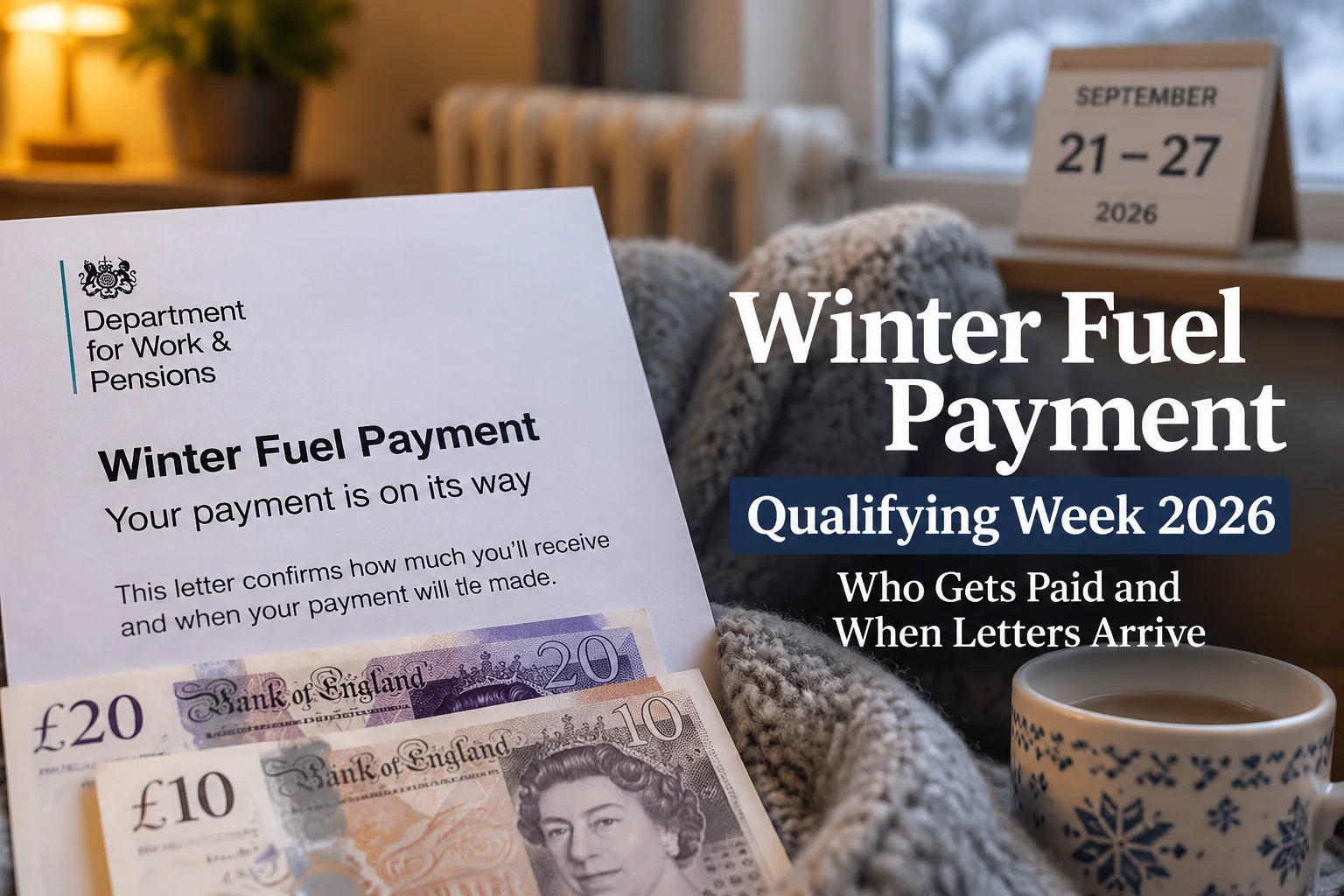
If you or someone in your household was born on or before 27 June 1960, the week that decides your Winter Fuel Payment this year is 21 to 27 September 2026. That is the qualifying week, and whatever your circumstances were during those seven days, not before or after, is what the Department for Work and Pensions uses to work out your payment. Most eligible households will receive somewhere between £100 and £300, with a confirmation letter arriving first in October or November and the money itself typically following in November or December.
Where people tend to trip up is assuming a flat £200 or £300 applies to everyone. It does not. Who you live with, and whether either of you claims Pension Credit, Universal Credit or income-related ESA, changes the amount considerably. The four exclusion groups are worth checking too, since meeting the age and income rules is not always enough on its own.
Start with the age and residency test. Anyone in a household with someone who has reached State Pension age and lives in England, Wales or Northern Ireland is in scope, provided they were born on or before 27 June 1960. Scotland is not covered by this scheme at all; it runs its own Pension Age Winter Heating Payment with separate rules, so anyone north of the border should look there instead.
The amount is where it gets genuinely fiddly. If you live alone, or nobody you live with also qualifies, you get £200 if you were born between 28 September 1946 and 27 June 1960, or £300 if you were born before 28 September 1946. Live with someone who also qualifies and neither of you claims a means-tested benefit, and the payment is shared and reduced: £100 each if you were both born in that 1946 to 1960 window, £150 each if you were both born before 1946, or a £100/£200 split if your birth dates fall either side of that line. Where a couple jointly claims Pension Credit, Universal Credit or income-related ESA, one of you gets the full £200 or £300 depending on both your ages, paid into the account your benefit normally lands in. Anyone claiming one of those benefits individually, rather than as part of a joint claim, also gets the full £200 or £300 themselves. Care home residents on a qualifying benefit get £100 or £150 rather than the full amount. On top of all that, anyone with taxable income over £35,000 will have the payment recovered later, either through their tax code or a Self Assessment return.
The four exclusions sit on top of the age and income rules. You will not receive the payment if you normally live outside England, Wales or Northern Ireland, if you spent the entire qualifying week and the equivalent week the year before in hospital receiving free treatment, if your UK immigration permission specifically bars you from claiming public funds, or if you were in prison for the whole of the qualifying week. A partial week inside, whether in hospital or prison, does not trigger the exclusion on its own. Care home residents have a separate wrinkle: anyone who has lived there continuously since 29 June 2026 or earlier while receiving Pension Credit, Universal Credit or income-related ESA will not get the payment at all, rather than the reduced £100 or £150 rate.
Most people do not need to apply. You will not need to claim if you already get State Pension, Pension Credit, Universal Credit or a range of other benefits including Attendance Allowance, PIP, Carer’s Allowance or DLA. A claim is only needed if you have never had a Winter Fuel Payment before, or if you have deferred your State Pension since your last one. Claims for winter 2026 to 2027 open from 21 September 2026; the closing date for this year’s claims had not yet been published at the time of writing, so anyone in that position should check gov.uk closer to the time rather than assume a fixed cut-off.