Reviewed and last updated on September 22, 2026 by Awais Ahmed, Founder & Editor-in-Chief, Urban Scope News.
If you’ve ever started your car, taken your foot off the brake, and felt a faint clunk or pulse travel up through the pedal, you’ve already met ABS Testauslösung — you just didn’t know it had a name. It’s German for “ABS test trigger” or “ABS self-test activation,” and it’s one of the quieter, more reassuring things your car does for you every single time you drive it.
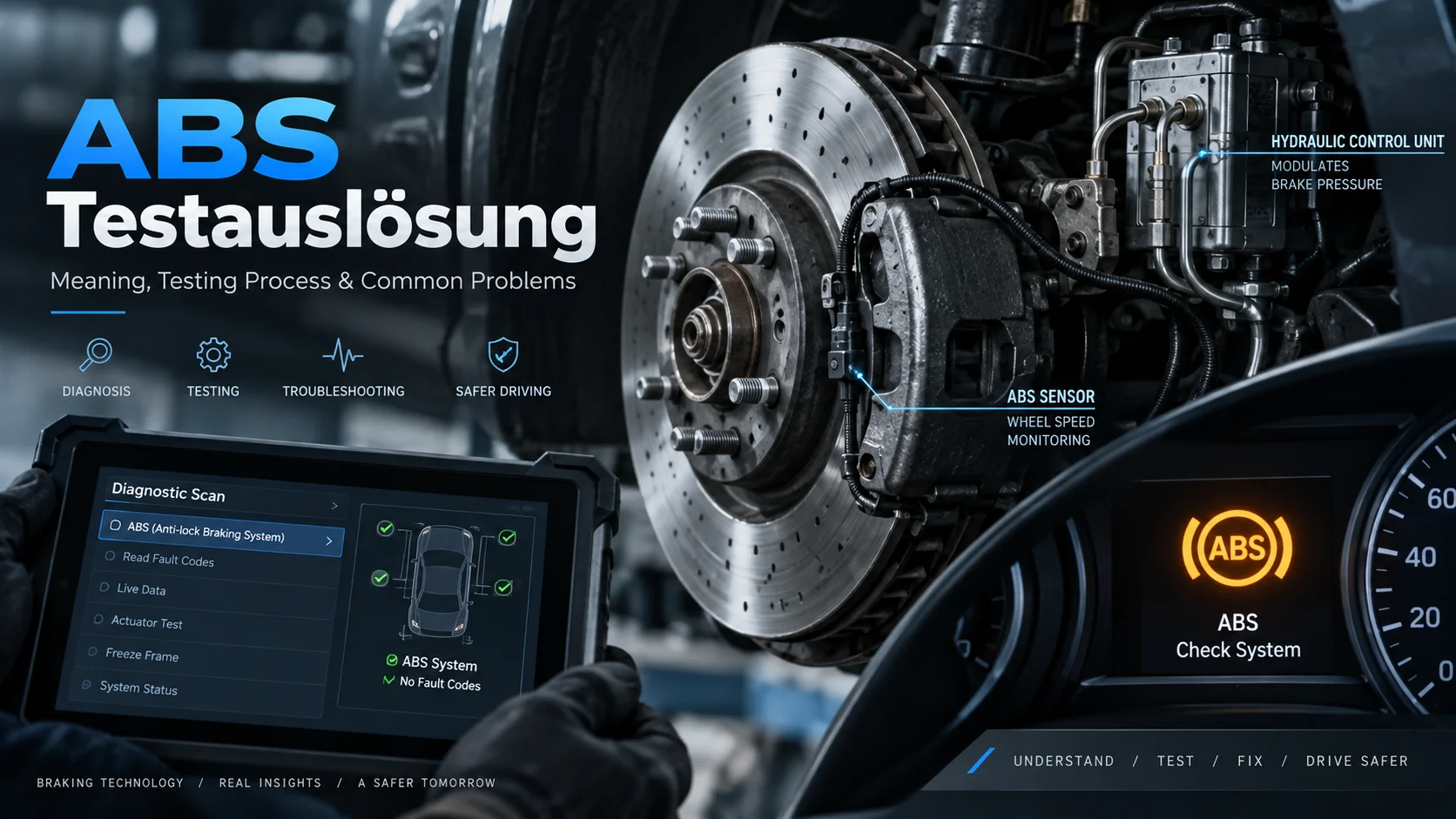
The term breaks down simply enough. ABS stands for Antiblockiersystem — the anti-lock braking system that keeps your wheels from locking up and skidding when you brake hard. Test means exactly what it sounds like. Auslösung translates to “triggering” or “activation.” Put together, ABS Testauslösung is the moment your car’s computer wakes up the ABS system and runs it through a quick health check before you actually need it.
So What Is Actually Happening?
Most modern cars run this check automatically, without you asking for it. It typically happens right after you start the engine and lift your foot off the brake pedal — the ABS control unit briefly cycles its hydraulic pump and valves to confirm everything is working. A second, similar check can happen again a few seconds into your drive, usually at low speed. Manufacturers from Nissan to Volvo describe this exact behavior in their owner’s manuals: a short “clunk,” tick, or pulsing sensation in the pedal that has nothing to do with anything being wrong. It’s the system flexing its muscles, not straining them.
There’s a second, more specialized meaning of the term that shows up in repair shops rather than driveways. When a technician works on your brakes — especially after replacing an ABS hydraulic unit or bleeding the brake lines — a standard code reader often isn’t enough to fully clear trapped air or confirm the pump and valves are behaving. For that, mechanics use bidirectional diagnostic tools that can actively command the ABS pump and solenoid valves to cycle on demand, as part of a proper brake bleed or post-repair check. This is a real, documented function built into professional scan tools (VCDS and similar platforms use it constantly for VW and Audi brake service, for instance), even though it’s a narrower, more specialized use of the term than the everyday self-test every driver already experiences.
Why the Self-Test Exists
Your ABS system is only useful if it works exactly when you need it — during a panic stop on a wet road, or a sudden swerve to avoid something in your lane. The problem is that ABS rarely gets used in day-to-day driving; most trips never involve hard enough braking to trigger it. Without some way to check on itself, a fault could sit hidden for weeks before an emergency stop revealed it, which is exactly the wrong moment to find out.
The self-test solves that by giving the system a low-stakes opportunity to prove it’s ready. Wheel speed sensors, the hydraulic pump, and the solenoid valves all get a quick workout, and the control unit confirms each one is responding and communicating correctly. If something’s off, it won’t wait for a crisis to tell you — it’ll light up the ABS warning symbol on your dashboard right away.
What the ABS Warning Light Is Actually Telling You
Here’s the part that trips people up: if the light comes on briefly during startup and then goes off, that’s completely normal — it’s just part of the bulb check every dashboard runs. What matters is whether it stays on.
A persistent ABS light usually points to one of a few culprits. A dirty or damaged wheel speed sensor is the most common — these sit close to the road and pick up grime, corrosion, or physical knocks over time, and a bad reading from just one wheel is enough to trip the whole system into a fault state. Low brake fluid is another frequent cause, since the ABS module needs adequate hydraulic pressure to do its job. Less often, the issue traces back to the control module itself or to wiring that’s frayed, corroded, or has a loose connector somewhere in the harness.
The good news is that a lit ABS light doesn’t mean your brakes have stopped working. Your normal braking system — pads, rotors, the hydraulics you use every day — keeps functioning on its own. What you lose is the anti-lock protection, meaning a hard stop on a slick surface could cause your wheels to lock and skid the way they would in an older car without ABS at all. It’s not an emergency, but it’s not something to put off either, especially heading into wet or icy weather.
What This Looks Like at a Repair Shop
When you bring a car in with a stuck ABS light, a technician’s first move is usually to plug in a scan tool and pull whatever fault codes are stored in the ABS module. Those codes point toward a general area — a specific wheel sensor, the pump circuit, a communication error — long before any parts come off the car. From there, live sensor data can confirm whether a suspect component is actually misbehaving or whether the code was triggered by something else, like a wiring fault upstream of the sensor itself.
If the repair involves opening up the hydraulic side of the system — replacing the ABS module or the hydraulic unit, for example — that’s when the active triggering function comes into play. The technician can command the pump and valves to cycle directly through the scan tool, both to bleed any trapped air out of the lines properly and to confirm the new or repaired component is actually responding the way it should before the car goes back on the road.
This isn’t something you can meaningfully replicate with a basic code reader from an auto parts store. Reading a stored fault code is easy; actively commanding ABS components and interpreting how they respond takes the kind of bidirectional tool — and the training to use it — that most home garages don’t have. If your light stays on, a proper diagnostic scan is worth the trip to a shop rather than guessing at parts.
Keeping Your ABS System Healthy
There’s no special maintenance ritual for ABS beyond taking care of the brake system as a whole. Keeping brake fluid at the right level and replacing it on the schedule your manufacturer recommends matters more than people expect, since old, moisture-contaminated fluid affects hydraulic pressure throughout the system, ABS included. Regular brake inspections catch worn pads, damaged lines, and grimy sensors before they turn into warning lights. And when a warning light does appear, treating it as worth a look sooner rather than later tends to mean a smaller repair bill and less risk in the meantime.
Frequently Asked Questions
What does ABS Testauslösung mean in English? It translates to “ABS test trigger” or “ABS self-test activation” — the automatic check your car’s anti-lock braking system runs on itself, usually right after startup.
Is it something wrong with my car? No. Feeling a pulse in the pedal or hearing a clunk right after starting the engine is the system testing itself, not a fault.
Why does the ABS light stay on after the test? A light that stays lit, rather than flashing briefly during startup, usually means the system found a real issue — most often a wheel speed sensor, low brake fluid, or a wiring problem — and it’s worth having checked.
Can I still brake normally if the ABS light is on? Yes. Your regular brakes keep working; you just lose the anti-lock protection that prevents wheel lockup during hard braking, particularly on wet or icy roads.
Can I fix this myself with a basic OBD scanner? You can often read the stored fault code yourself, which at least points you toward the problem. Actually resolving it — especially anything involving actively cycling the pump or valves — generally needs a professional bidirectional scan tool and some know-how.
Does the self-test happen every time I drive? The startup check runs essentially every time you start the car and release the brake. A second low-speed check may also occur shortly after you begin driving, depending on the vehicle.