Reviewed and last updated on September 7, 2026 by Awais Ahmed, Founder & Editor-in-Chief, Urban Scope News.
A pelican crossing is a pedestrian-operated, traffic-light-controlled crossing recognised by its far-side red and green pedestrian figures and, most importantly, a flashing amber phase for drivers. A pedestrian presses a button to request a crossing phase. Traffic is eventually stopped by a red light, pedestrians receive a steady green figure, and a flashing green figure then gives people already crossing time to finish.
For drivers, the feature that makes a pelican crossing distinctive is flashing amber after the red light. Drivers must give way to pedestrians who are still on the crossing, but may proceed cautiously once the crossing is completely clear. This is different from newer puffin, toucan and equestrian crossings, which do not use the pelican flashing-amber phase.
What is a pelican crossing?
The pelican crossing meaning is contained in its name. Pelican developed from pedestrian light controlled, traditionally abbreviated as PELICON before the spelling evolved into the more memorable bird name. UK local-authority guidance still describes it as a pedestrian light-controlled crossing.
Unlike a zebra crossing, where no red traffic signal is used to stop vehicles, a pelican uses traffic lights to create a dedicated pedestrian phase.
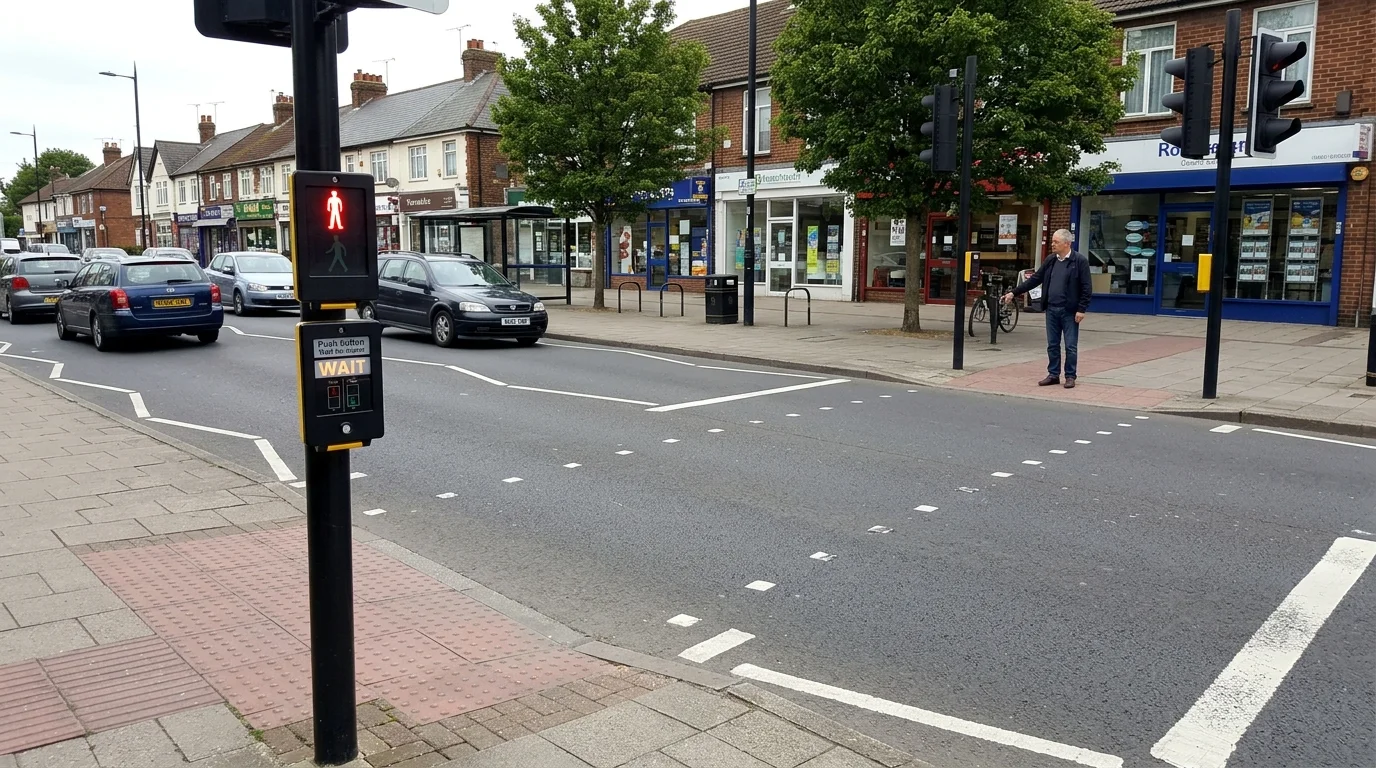
A traditional pelican crossing normally has a pedestrian push button, a WAIT indicator, far-side red and green pedestrian figures, normal red, amber and green vehicle signals, a solid white stop line and zig-zag markings around the crossing.
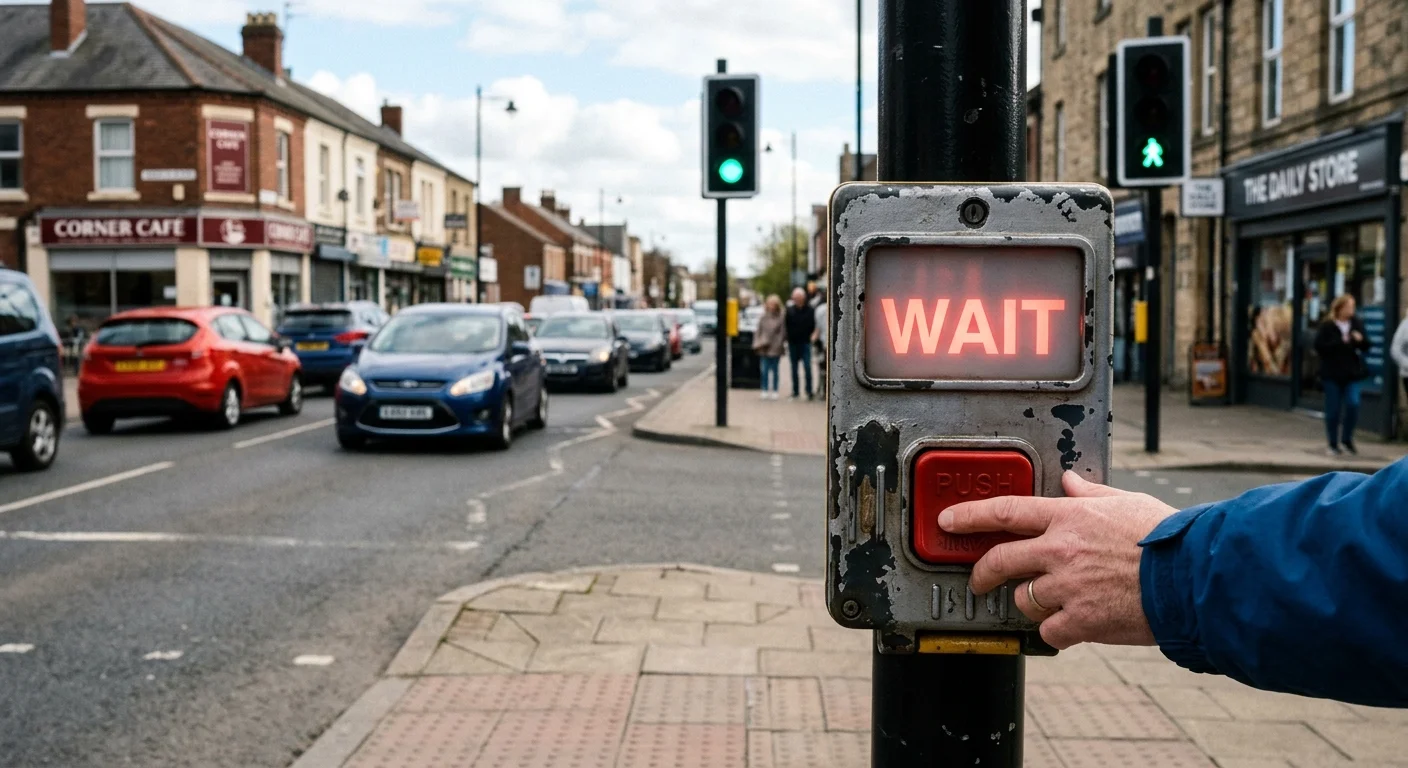
The most useful identifying clue is not a special pelican crossing sign. It is the combination of far-side pedestrian signals and the flashing green and flashing amber phase. The Department for Transport defines a pelican crossing in terms of far-side pedestrian indicators and this flashing signal period.
How does a pelican crossing work?
Using a pelican crossing begins when a pedestrian presses the push button. Pressing it registers a request for the pedestrian stage. The lights do not necessarily change immediately because the signal controller must first reach the appropriate point in its operating cycle.
When the pedestrian phase begins, drivers receive a red signal and must stop. Pedestrians then see a steady green figure.
The Highway Code tells pedestrians to check that traffic has actually stopped before entering the road, even when the green figure is showing.
Near the end of the pedestrian phase, the green figure begins flashing. A pedestrian who has not started crossing should wait. Someone who is already crossing should continue and should have time to reach the other side safely.
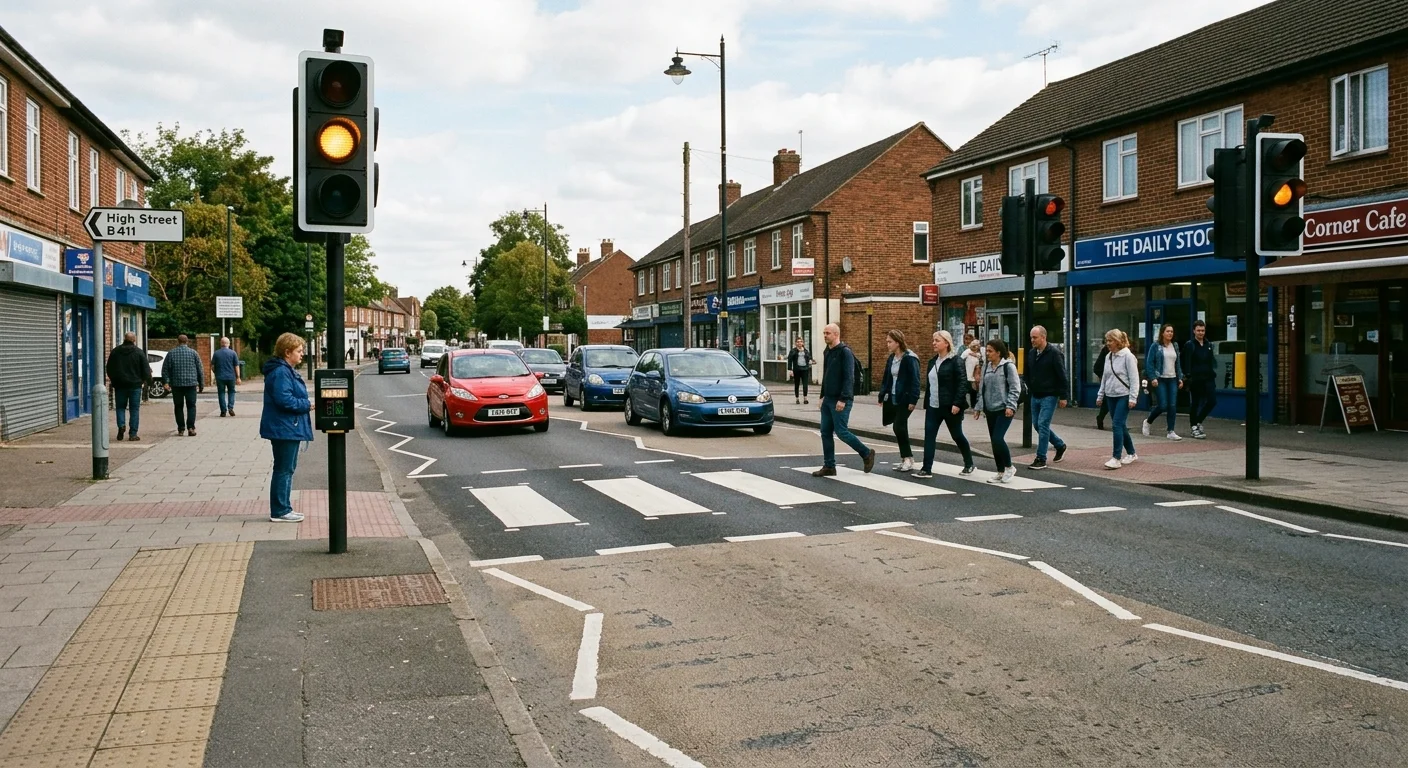
At approximately the same stage, motorists move from red to flashing amber.
That flashing amber signal is the defining feature of a pelican crossing.
What is the pelican crossing light sequence?
For motorists, the sequence is:
| Signal | What it means |
|---|---|
| Green | You may proceed if the road and crossing are clear. |
| Steady amber | Stop unless you have already crossed the stop line or are so close that stopping could cause a collision. |
| Red | You must stop behind the stop line. |
| Flashing amber | Give way to pedestrians still on the crossing. If it is completely clear, you may proceed with caution. |
| Green | Normal traffic movement resumes, but you must still give way to anyone who has not finished crossing. |
The prescribed pelican sequence for vehicular signals is steady green, steady amber, steady red and flashing amber before returning to green.
This also answers a common learning-to-drive question: what colour follows green at a pelican crossing?
For drivers, steady amber follows green. Flashing amber comes later, after red.
That distinction matters because ordinary steady amber and pelican flashing amber have different meanings.
What does flashing amber mean at a pelican crossing?
A pelican crossing flashing amber light means that the driver may move only if the crossing is clear.
If a pedestrian is still on the crossing, the driver must give way and wait. If there are no pedestrians on the crossing, the driver may proceed cautiously. Highway Code Rule 196 states this explicitly.
Flashing amber therefore does not mean accelerate before the light changes. It creates a conditional permission to proceed.
There is another important rule learners sometimes miss. If the signal has already returned to green but somebody is still crossing, drivers should still give way. Highway Code Rule 198 applies this principle to all crossings.
Do you have to stop at a pelican crossing?
It depends on the signal and whether pedestrians are present.
At a red light, drivers must stop.
At flashing amber, drivers must give way to pedestrians on the crossing. If nobody is on it, they may proceed cautiously.
At green, drivers may normally continue, although they must not drive into someone who is still completing the crossing.
Drivers should also avoid entering a pedestrian crossing when queuing traffic prevents them from clearing it. The Highway Code says crossings should be kept clear rather than blocked by stationary traffic.
What should pedestrians do?
For pedestrians, the sequence is simpler.
A red standing figure means wait. A steady green walking figure means check that traffic has stopped and then cross with care. When the green figure begins flashing, pedestrians who have not started should not enter the road. Anyone already crossing should continue without unnecessary delay.
The Highway Code also states that pedestrians must not loiter on crossings and should cross between the studs rather than wandering into the surrounding zig-zag area.
Some crossings also provide audible or tactile assistance for people with visual or hearing impairments. The Highway Code notes that crossings may use a bleeping or voice signal for blind or partially sighted pedestrians and a tactile signal for deafblind pedestrians.
What happens when there is a central island?
Central islands create one of the most important distinctions to understand at a pelican crossing.
If a pelican crossing runs in a straight line across the road, it is treated as one crossing even when there is a central island. Drivers must wait for pedestrians crossing from the other side of that island rather than assuming that only their half of the road matters. Highway Code Rule 197 confirms this.
A staggered pelican crossing works differently.
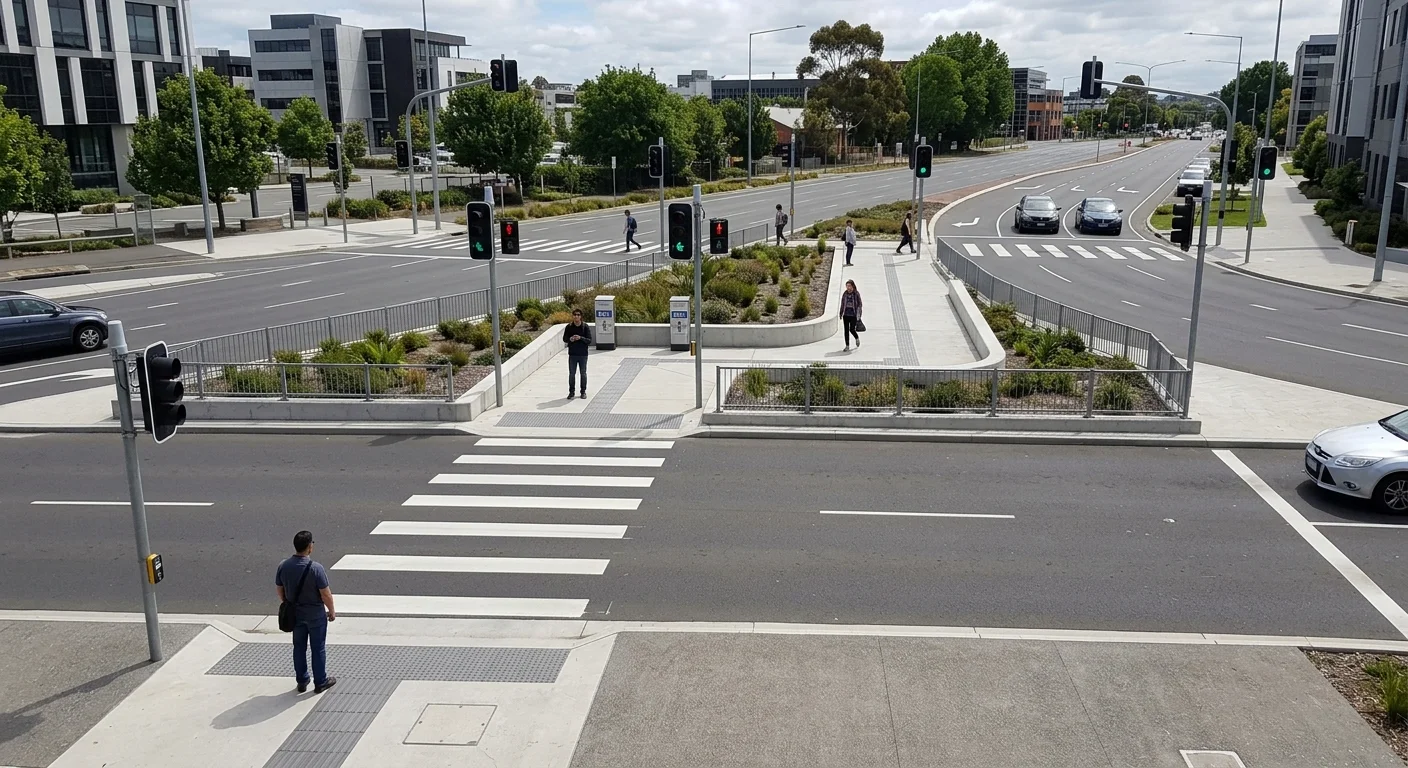
If the two crossing sections are offset from each other on either side of the central refuge, they are treated as two separate crossings. Pedestrians reaching the island should press the second button and wait for another steady green figure before crossing the remaining section.
This is also an important difference from a zebra crossing, where a central island normally divides the crossing into two separate crossings.
What do the zig-zag lines mean?
The white zig-zag markings before and after a pedestrian crossing are not decorative. They protect visibility around the crossing and carry restrictions for drivers.
Under the Highway Code, drivers must not park on a crossing or within the area covered by the zig-zag markings, except in narrow, limited circumstances. They must also not overtake the moving vehicle nearest the crossing or the vehicle nearest the crossing that has stopped to give way to pedestrians.
These rules matter because a parked or overtaking vehicle can hide pedestrians from other road users.
Can cyclists use pelican crossings?
Cyclists can use a pelican crossing as pedestrians, but the Highway Code tells them not to ride across it. Rule 79 is explicit: cyclists must dismount and wheel their bicycle across. The same rule applies to puffin and zebra crossings.
A toucan crossing is different. It is specifically designed so pedestrians and cyclists can cross together, and cyclists are permitted to ride across when the appropriate signal is displayed.
For learners, a simple distinction is therefore:
- Pelican: pedestrian crossing, cyclists dismount.
- Toucan: pedestrians and cyclists can cross, and cyclists may ride.
Pelican vs puffin crossing
Pelican and puffin crossings can look similar from a distance, but their operation is different.
| Feature | Pelican crossing | Puffin crossing |
|---|---|---|
| Pedestrian operated | Yes | Yes |
| Pedestrian figures | Far side of the road | Normally near side, above the control box |
| Steady green pedestrian figure | Yes | Yes |
| Flashing green pedestrian figure | Yes | No |
| Flashing amber for drivers | Yes | No |
| Pedestrian detection | Does not use puffin-style on-crossing detection | Uses pedestrian detection |
| Current status in Great Britain | Existing sites may remain | Used as a modern alternative |
A puffin crossing can detect pedestrian movement and adjust the crossing period according to need. It can also cancel a pedestrian request if the person who pressed the button leaves before the crossing phase begins.
That is more precise than describing every pelican simply as fixed timing. The important distinction is that a pelican does not use the puffin system of pedestrian detection to adapt the clearance period according to somebody still crossing.
Pelican vs zebra crossing
A zebra crossing uses black-and-white road markings and Belisha beacons rather than red, amber and green traffic signals.
Drivers approaching a zebra should give way to pedestrians waiting to cross and must give way once a pedestrian has moved onto the crossing.
A pelican crossing instead regulates the interaction through pedestrian and vehicle signals.
Another difference involves central islands. A zebra crossing with a central island is normally treated as two crossings, whereas a straight-through pelican with an island remains one crossing.
Why is it called a pelican crossing?
The name comes from pedestrian light controlled crossing. The wording was compressed into PELICON and subsequently became pelican, producing a memorable name that fitted neatly into Britain’s collection of animal-associated crossing terminology.
Other names developed differently. Puffin is associated with pedestrian user-friendly intelligent crossing, while toucan is a play on two can cross, referring to pedestrians and cyclists. Pegasus crossings take their name from the mythical winged horse because they cater for horse riders.
Why 1969 matters
The modern pelican became part of Britain’s national regulatory system through the Pelican Pedestrian Crossings Regulations and General Directions 1969, Statutory Instrument 1969 No. 888.
It is better to describe 1969 as the year in which the pelican was formally established in the national regulatory framework rather than suggesting Britain had never experimented with light-controlled pedestrian crossings before then. An earlier trial design, the panda crossing, ran from 1962 but was withdrawn after proving confusing for both drivers and pedestrians.
The pelican went on to become a familiar feature of British streets and remained important enough that later regulations in 1987 and 1997 continued to prescribe its operation.
What law applies to pelican crossings today?
This is an area where older articles can easily become outdated.
For England, Scotland and Wales, the key modern framework is the Traffic Signs Regulations and General Directions 2016 (TSRGD 2016), together with relevant provisions of the Road Traffic Regulation Act 1984. The 2016 Regulations revoked the Zebra, Pelican and Puffin Pedestrian Crossings Regulations 1997 while preserving arrangements for existing pelican installations.
The Highway Code translates those requirements into practical rules. Rule 191 covers parking and overtaking restrictions around pedestrian crossings, Rule 196 covers red and flashing amber at pelican crossings, Rule 197 covers straight crossings with central islands, and Rule 198 tells drivers to give way to anyone still crossing after the signal changes to green.
Northern Ireland has a separate legal framework. Relevant rules include the Road Traffic Regulation (Northern Ireland) Order 1997 and the Zebra, Pelican and Puffin Pedestrian Crossings Regulations (Northern Ireland) 2006. The practical Highway Code rule remains the same: stop on red, give way to pedestrians during flashing amber, and proceed cautiously during flashing amber only when the crossing is clear.
Are pelican crossings still being installed?
This is where the UK-wide picture differs.
In England, Scotland and Wales, new pelican crossings may no longer be installed under the current regulations. Existing crossings can remain until they reach the end of their operational life. The Department for Transport’s Traffic Signs Manual states this explicitly.
The government’s Know Your Traffic Signs guidance likewise says pelican crossings are no longer being installed but that many existing examples remain.
In Northern Ireland, pelican crossings continue to operate under their own regulations, and the phase-out that applies in Great Britain does not automatically extend across the border.
This distinction is why describing pelicans simply as banned throughout the UK or completely obsolete would be inaccurate.
The key rule to remember when learning to drive
For a learner driver, the easiest feature to associate with a pelican crossing is flashing amber.
Red means stop.
Flashing amber means give way to anybody still crossing, but proceed cautiously if the crossing is completely clear.
And remember the sequence: green, steady amber, red, flashing amber, green.
For pedestrians, the corresponding rule is equally simple: a steady green figure means check traffic has stopped and cross; a flashing green figure means do not start, but finish crossing if you are already on the road.
That flashing amber and flashing green phase is what makes the traditional pelican crossing different from the newer crossing systems now seen across much of Britain.