Reviewed and last updated on October 17, 2026 by Awais Ahmed, Founder & Editor-in-Chief, Urban Scope News.
Incfidelibus is not a recognised word in Latin or English. It is almost certainly a misspelling of infidelibus, a genuine Latin form that translates roughly as ‘to the unfaithful’ or ‘for the unbelievers’, with an extra c that no Latin dictionary supports. The same spelling also has a second life online as a name attached to phone-hacking and monitoring claims, which is why searching for it can lead to results that have nothing to do with language.
Most people who stumble across the word assume it is ancient, philosophical or the name of an app. The evidence supports none of those readings. This guide separates what can be checked from what has simply been repeated across websites, and explains what to do if the name turns up somewhere unexpected.
The Latin word behind the spelling
Latin builds many of its words from short roots, and this one starts with fides, the noun for faith, trust and good faith. Add an adjective ending and you get fidelis, meaning faithful or trustworthy. Put the negative prefix in- in front and the result is infidelis: someone who does not keep faith, or who is disloyal.
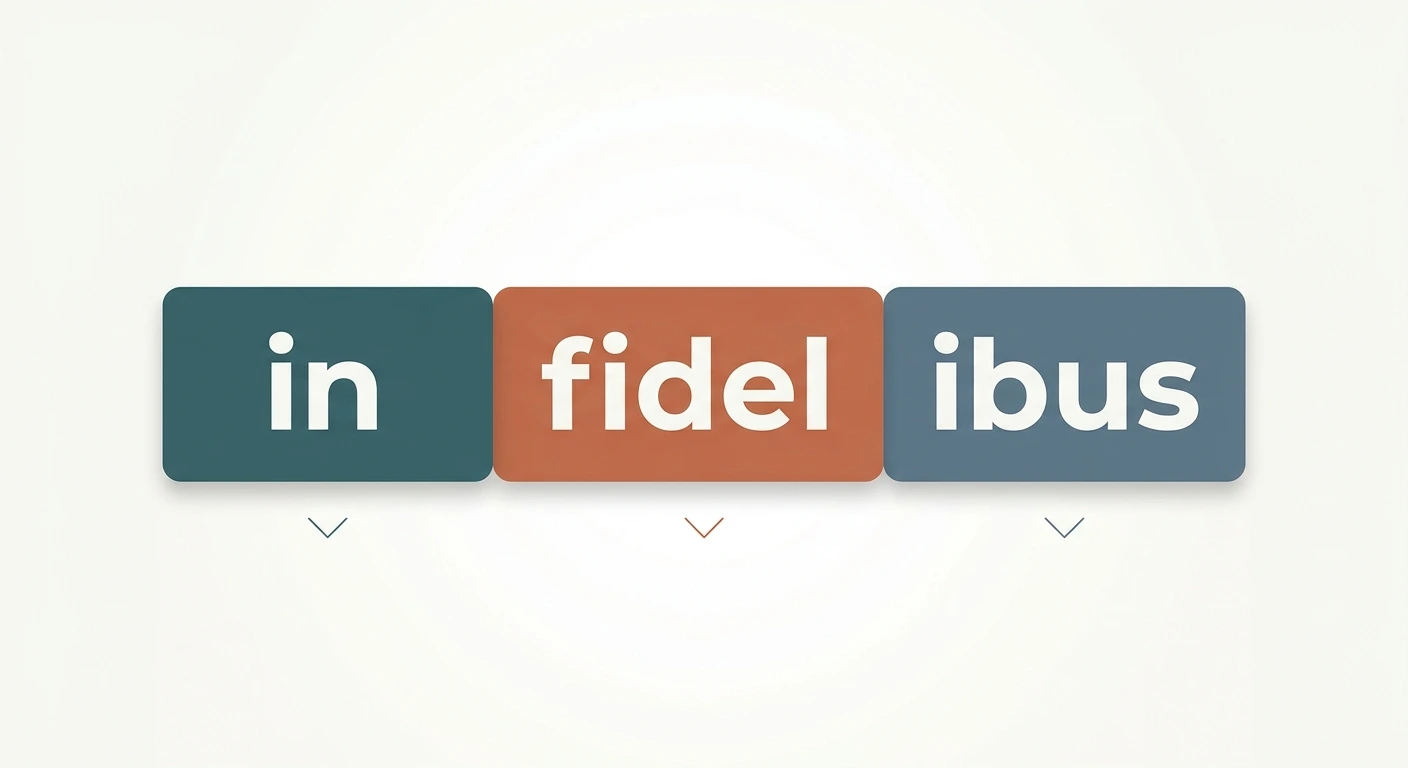
That older sense is worth holding on to. In classical Latin, infidelis was about loyalty and reliability, so it could describe a treacherous ally or an unreliable friend. The religious meaning of an unbeliever developed later, in Late Latin, and it is the sense that passed into English. Merriam-Webster’s etymology for the English word infidel follows exactly this route, from Late Latin infidelis meaning unbelieving back to an earlier Latin sense of not keeping faith.
How infidelibus fits in
Latin changes word endings to show a word’s job in a sentence. Infidelis is an adjective of the third declension, and infidelibus is its dative or ablative plural. One spelling therefore covers several English renderings, such as ‘to the unfaithful’, ‘for the unbelievers’ or ‘with the faithless’, and only the surrounding sentence shows which one fits. A translation of the word on its own is always a little unsafe, which is one reason confident one-line definitions online deserve suspicion.
Is incfidelibus a real Latin word?
No. Latin has no recorded word spelt this way, and the extra c plays no grammatical role, because the prefix in- attaches directly to fidelis. Treating incfidelibus as a Latin term in its own right, or reading ideas about loyalty, identity and personal values into it, goes beyond what the evidence supports. The genuine Latin word does concern faithfulness, which is probably why so many articles drift towards those themes, but one word’s meaning cannot simply be lent to a different spelling.
Why the extra letter appears at all has not been established. Some explainers suggest a typing slip or a scanning error, yet none of the pages reviewed for this article points to an original document where that happened, so these remain guesses. What can be shown is that the spelling has been used as a name, and that is where the story becomes less comfortable.
The other incfidelibus: a name tied to phone-hacking claims
Away from Latin, the spelling has a documented history. Older web pages and review listings associate the name IncFidelibus with services advertising mobile phone monitoring and hacking, including access to messaging apps such as WhatsApp. A Trustpilot profile for incfidelibus.com carries two reviews from around early 2020, both critical. The reviewers allege that they paid for a hacking service and received nothing usable. Those are customer allegations, not findings by a court or regulator, and two reviews are too few to describe a pattern.
Separately, the name appears in the comment sections of review pages for unrelated phone-monitoring products. Several posts there recommend contacting an IncFidelibus email address for remote access to someone else’s phone. Testimonials of this kind are a familiar form of promotional spam, and nothing on those pages allows the people posting them to be verified.
There are limits to what any of this proves. It does not show who ran the service, whether it ever worked as advertised, or whether it has any link to websites that use the name today. A site at incfidelibus.com now appears to publish general articles, and it should not be assumed to be the same operation as the older service without evidence. Some explainers also claim the spelling has turned up in scam emails. That may be true, but none of those pages reproduces an example or names a source, so it is best treated as unconfirmed.
Why the term has surged in search results
Obscure terms can climb quickly without any major event behind them. Someone meets an odd word and searches for it, publishers who watch keyword data notice the demand, and explainers follow. Every new page adds to the pile of results, which prompts yet more searches. Through late summer and autumn 2026, numerous near-identical articles chased this term, and many of them present loyalty, identity or ancient philosophy as established meaning without citing anything.
The same cycle has played out with other unfamiliar names, such as a platform whose origins also had to be pieced together carefully before anyone could say what it was. The honest position on incfidelibus is that nobody has shown what first triggered the interest, and the volume of articles is not evidence that the word has a deeper meaning.
What to do if you come across the name
The right response depends on where you found it. If it appeared in a book, a quotation or a piece of text you are translating, the sensible step is to look up infidelibus in a Latin dictionary and read the full sentence, since the case ending and the context decide the meaning.
If it appeared in an email, message or comment offering to hack or monitor someone’s phone, do not engage. Customer complaints about the older service describe payment without delivery, and the activity being offered is the real problem. Section 1 of the Computer Misuse Act 1990 makes it an offence to cause a computer to perform any function with intent to secure unauthorised access to programs or data, and conviction on indictment can carry up to two years in prison. Reading someone’s messages or accounts without their permission can fall within that, whatever the relationship. The same caution applies to tools that promise covert access to someone’s social media activity, which tend to promise far more than they can deliver.
If you have already paid or handed over details, contact your bank or card provider promptly, change the passwords for any accounts you shared, and report the matter through official UK fraud reporting channels. If you suspect that someone is monitoring your own phone, speak to the police or a specialist support service rather than searching for spy tools, because the search results for this subject are crowded with the very offers described above.
Frequently asked questions about incfidelibus
What does incfidelibus mean?
Incfidelibus has no established meaning of its own. It resembles infidelibus, a Latin form of infidelis that means unfaithful, disloyal or unbelieving depending on the era and context.
Is incfidelibus a real Latin word?
No standard Latin source records it. The recognised form is infidelibus, without the extra c.
Is incfidelibus the same as infidelibus?
They are not interchangeable. Infidelibus is the dative or ablative plural of a documented Latin adjective, while incfidelibus is a non-standard spelling. If you mean the Latin word, use infidelibus.
Was incfidelibus a hacking service?
Older web pages and review listings link the name IncFidelibus to phone-monitoring and hacking promotions. The details of who operated it, and whether it still exists in that form, have not been established.
Is incfidelibus a scam?
Two customers on a review platform alleged that they paid and received nothing usable, but those are allegations rather than legal findings. Anyone offering to hack or spy on another person’s phone is a risk worth avoiding, whatever name they use.
Does incfidelibus have a religious or philosophical meaning?
Not in any way that can be verified. The related Latin word has religious uses in Late Latin, but that does not give the misspelling a philosophy of its own.
The bottom line
Incfidelibus is best understood as a misspelling of a real Latin word that also became a name in some unsavoury corners of the internet. The Latin background is well documented, the origin of the extra letter is not, and the online history calls for caution rather than curiosity. Check the spelling, check the context, and treat any offer attached to the name as one to ignore.