Reviewed and last updated on September 14, 2026 by Awais Ahmed, Founder & Editor-in-Chief, Urban Scope News.
Iceland Foods introduced advanced sensor technology across its UK stores in early 2026 through a partnership with STRATACACHE, but the collapse of its technology partner has since put the future of the system in doubt.
The frozen food supermarket chain partnered with STRATACACHE, a US retail technology company, to expand its in-store retail media capabilities across Iceland and The Food Warehouse locations.
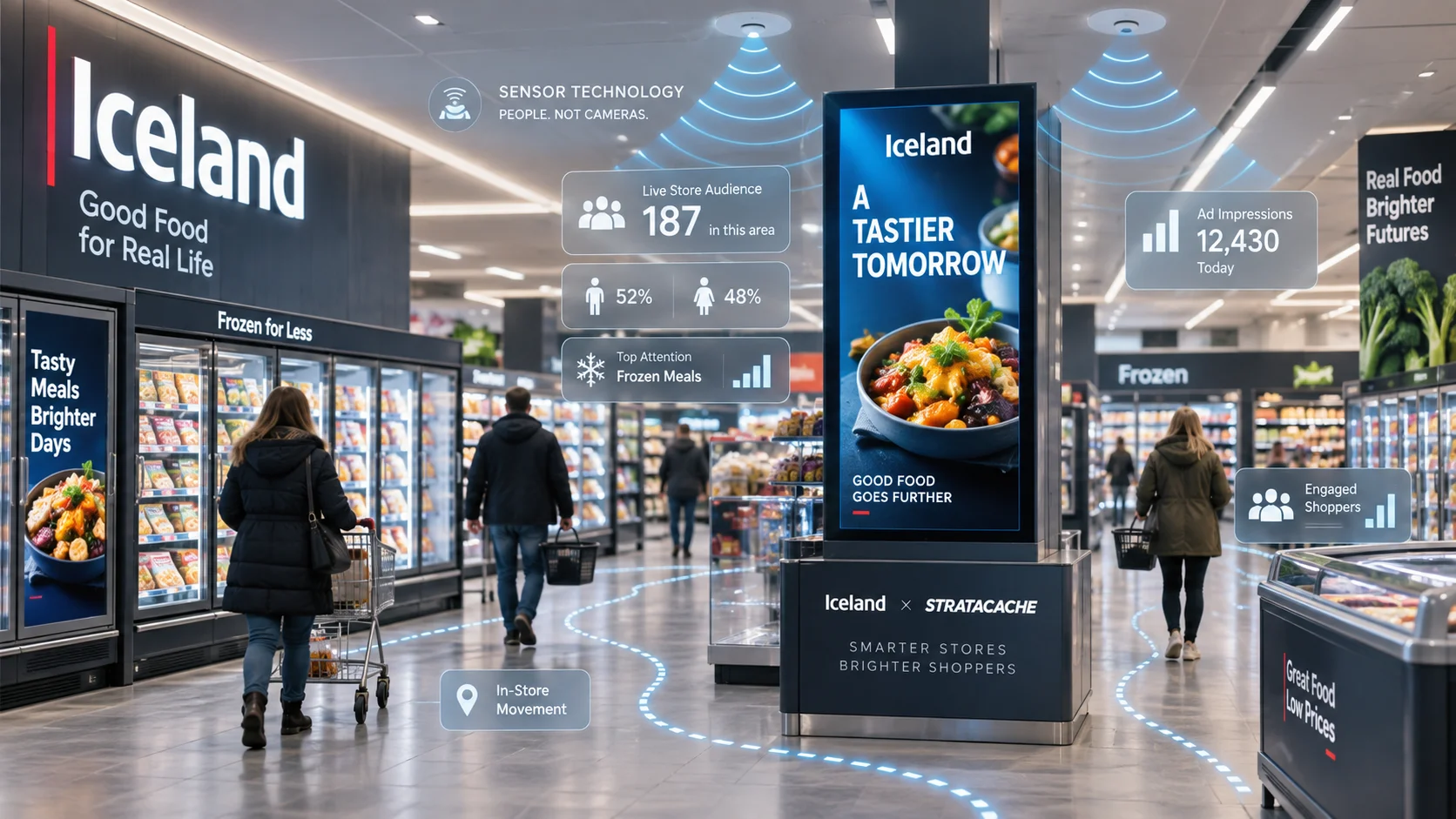
The rollout combined digital advertising screens with camera-free sensor analytics, letting retailers and advertisers measure how customers interact with in-store promotions.
Early results were promising. But just months into the deployment, STRATACACHE ran into serious financial difficulty, and the partnership’s long-term future is now unclear.
The move highlights the growing importance of retail media networks in the UK, where supermarkets are increasingly using their physical locations as advertising platforms similar to online environments, even as this case shows how dependent that model is on the technology partners behind it.
What Is STRATACACHE Sensor Technology?
The technology introduced by Iceland used STRATACACHE’s Walkbase platform, designed to provide anonymous shopper analytics inside physical retail spaces.
Unlike traditional camera-based tracking systems, the solution focused on sensor-based measurement rather than identifying individual customers. Instead of cameras, it used high-frequency radio wave sensors to track shopper movement, pathing, dwell time, and occupancy throughout the store.
The technology was designed to help retailers understand:
- How many shoppers are exposed to digital advertisements
- How customers move through store areas
- Which displays attract attention
- How advertising campaigns perform in physical locations
This gave brands more measurable insight into offline advertising performance, an area where digital platforms like search engines and social media have long had the advantage. Measuring the impact of physical store advertising has historically been far harder, and sensor technology aimed to close that gap.
Iceland’s Move Into Retail Media
Retail media has become one of the fastest-growing areas of advertising worldwide.
Supermarkets have a unique advantage because they already have:
- Large numbers of daily visitors
- Customer purchasing data
- Physical spaces close to purchase decisions
By combining digital screens with analytics technology, retailers can offer brands new advertising opportunities directly inside stores.
For Iceland, the partnership with STRATACACHE, which covered 766 of its 950 UK stores, marked the first time the Walkbase solution had been deployed by a European retailer, and represented a shift towards a more technology-driven supermarket advertising model.
Why Camera-Free Technology Mattered
Consumer privacy has become a major discussion point as retailers introduce more advanced technology.
Many shoppers are concerned about how cameras, artificial intelligence, and tracking systems collect information in public spaces.
STRATACACHE’s approach focused on camera-free analytics, designed to measure audience behaviour without using facial recognition or identifying individual shoppers. This was intended to align with consumer privacy best practice while avoiding the reliability issues cameras can face with lighting and reflective surfaces.
Early Results Show Potential Impact
According to STRATACACHE, early campaigns using Iceland’s digital retail media technology showed encouraging results. One condiment brand featured on the in-store digital screens saw a 10% increase in sales and a 17% increase in category share of transactions during the campaign activation period.
These results illustrated why retailers were investing in measurable in-store advertising technology, at a time when marketing budgets are increasingly focused on demonstrable performance rather than estimated reach.
STRATACACHE’s Collapse Puts the Rollout in Doubt
Despite the early momentum, STRATACACHE’s position changed sharply within months of the Iceland deal being announced.
Companies House filings confirmed that STRATACACHE appointed liquidators from insolvency practice, placing the company into liquidation. As the end-to-end technology partner for Iceland’s retail media network, responsible for the screens, sensors, and underlying software, STRATACACHE’s collapse leaves the system without the vendor needed to maintain and support it.
Reporting on the insolvency noted that the deal had been framed only months earlier as building “the most advanced in-store media network in the UK.” The sudden reversal means Iceland’s sensor-based advertising infrastructure could now be at risk, even though the stores themselves and their advertising hardware remain in place.
Iceland has not publicly confirmed how it plans to proceed, whether by finding a replacement technology partner or scaling back the retail media network. This is a developing story, and Urban Scope News will update this article as more details emerge.
How Smart Retail Technology Could Still Change Shopping Experiences
Even with STRATACACHE’s collapse, the underlying shift it represented is unlikely to disappear. If Iceland or another provider picks up where the rollout left off, possible developments include:
More Relevant Promotions
Retailers may use audience insights to display more relevant offers based on store areas and shopper behaviour.
Improved Store Layouts
Analytics can help businesses understand customer movement patterns and improve product placement.
Better Advertising Measurement
Brands can gain clearer information about whether customers notice and engage with their campaigns.
Connected Online and Offline Shopping
Retailers may combine digital shopping data with physical store insights to create more integrated customer experiences.
The Future of UK Supermarket Technology
Iceland’s partnership with STRATACACHE reflected a wider transformation happening across the retail sector, with supermarkets increasingly becoming connected digital environments rather than simply places to purchase products.
But the collapse of the technology partner behind the rollout is a reminder that this transformation depends on more than the technology itself. The financial stability of the companies supplying it matters just as much.
As UK supermarkets continue exploring digital solutions, sensor technology could still become an important part of the next generation of retail experiences, provided the vendors behind it can survive long enough to deliver on it.
Conclusion
Iceland Foods’ adoption of STRATACACHE sensor technology was a significant early step for UK retail innovation, combining digital displays, anonymous shopper analytics, and privacy-focused sensors in a new model for in-store advertising.
However, STRATACACHE’s subsequent collapse has left real questions over how, or whether, the system will continue. As retail media continues to grow in the UK, this case is a reminder that the technology behind these networks is only as reliable as the companies supplying it.