Reviewed and last updated on September 18, 2026 by Awais Ahmed, Founder & Editor-in-Chief, Urban Scope News.
Science laboratory technology is the applied study of laboratory skills and instrumentation used to support scientific research, industrial testing and healthcare diagnostics. Graduates work as laboratory technicians or technologists, carrying out the practical, hands-on tasks that scientists and researchers rely on, from preparing samples to running diagnostic equipment. It sits at the crossroads of chemistry, biology and physics, but the focus is technique rather than theory.
For anyone weighing this up as a career, a hiring decision, or simply trying to understand what the qualification covers, this guide breaks down what the field involves, the salary you can realistically expect in the UK and the US, the courses and degrees available, and exactly where a science laboratory technology background can take you.
What Does Science Laboratory Technology Actually Involve?
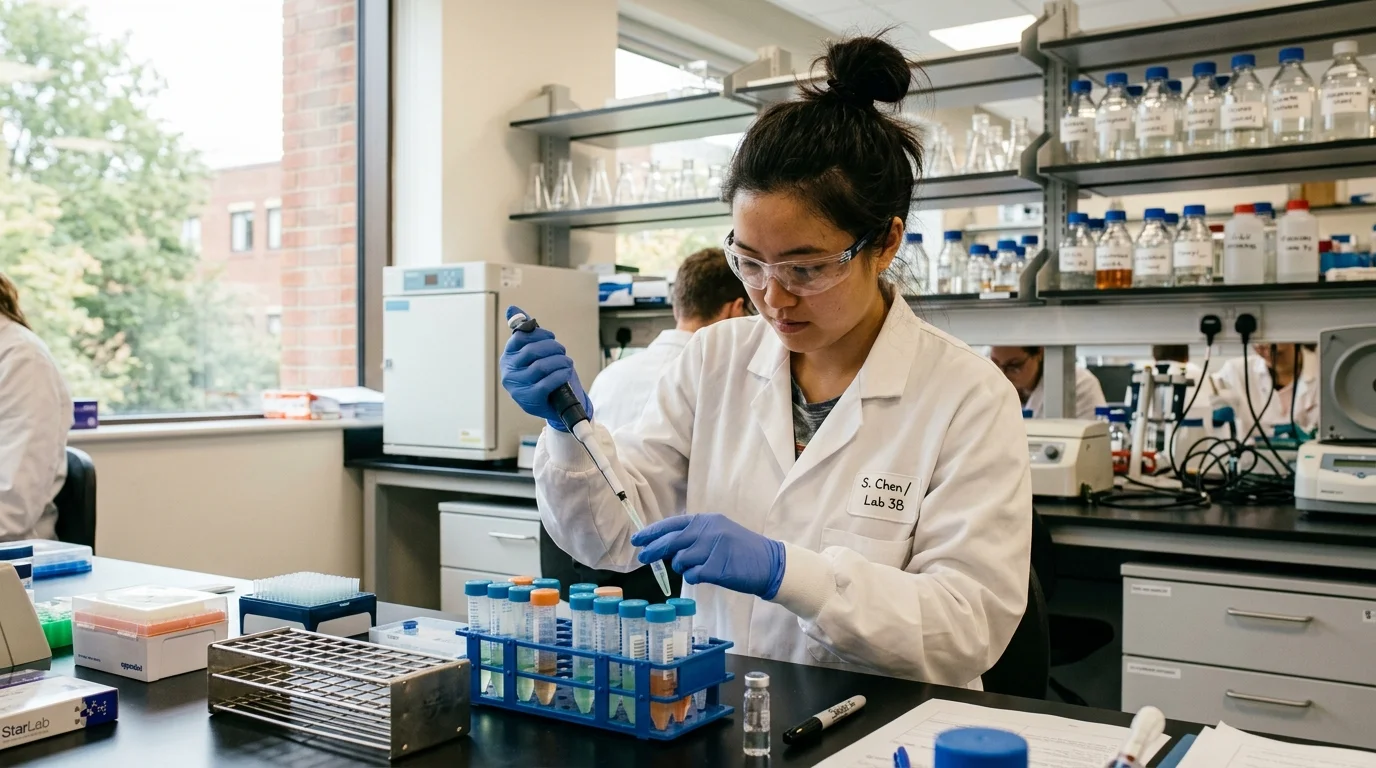
At its core, this is a technical discipline built around doing science rather than designing it. Students and graduates learn to:
- Set up and run experiments safely, including risk assessments
- Prepare solutions, cultures, tissue samples and specimens
- Operate and calibrate laboratory instruments such as spectrophotometers, centrifuges and chromatography equipment
- Record, analyse and report data accurately
- Maintain sterile conditions and dispose of chemical or biological waste correctly
- Manage stock, equipment maintenance and quality control documentation
Programmes typically combine common first-year training in chemistry, microbiology, instrumentation and quality systems with a specialisation in the second year, such as cell and microbiology, chemistry and quality analysis, or quality assurance. The second year of a typical science laboratory technology programme allows students to choose a specialisation such as cell and microbiology, chemistry and quality analyst, or quality assurance, building on foundational training in chemistry, microbiology, instrumentation and quality systems.
Where Can Science Laboratory Technology Graduates Work?
This is one of the most searched questions around the qualification, and the honest answer is: almost anywhere that has a laboratory. As one long-serving instructor on a science laboratory technology programme put it, opportunities exist “anywhere that has a small lab in the back or a large lab in the front,” and there is no such thing as a typical job in the field.
Typical employers and settings include:
- Hospitals and healthcare providers (pathology, blood testing, diagnostics support)
- Pharmaceutical and biotechnology companies
- Government laboratories, including public health and microbiology institutes
- Universities and research institutions
- Food, drink and agricultural testing facilities
- Environmental agencies, testing water, soil and air quality
- Forensic science units
- Manufacturing and industrial quality control labs, including oil, gas, paint and plastics
- Schools, colleges and further education, supporting practical science teaching
Graduates typically apply their foundational biology and chemistry knowledge across a wide range of disciplines, including chemical analysis, research, quality assurance, pharmaceuticals and biotechnology, working in industrial, government or commercial laboratory settings.
Can Science Laboratory Technology Graduates Work in Hospitals?
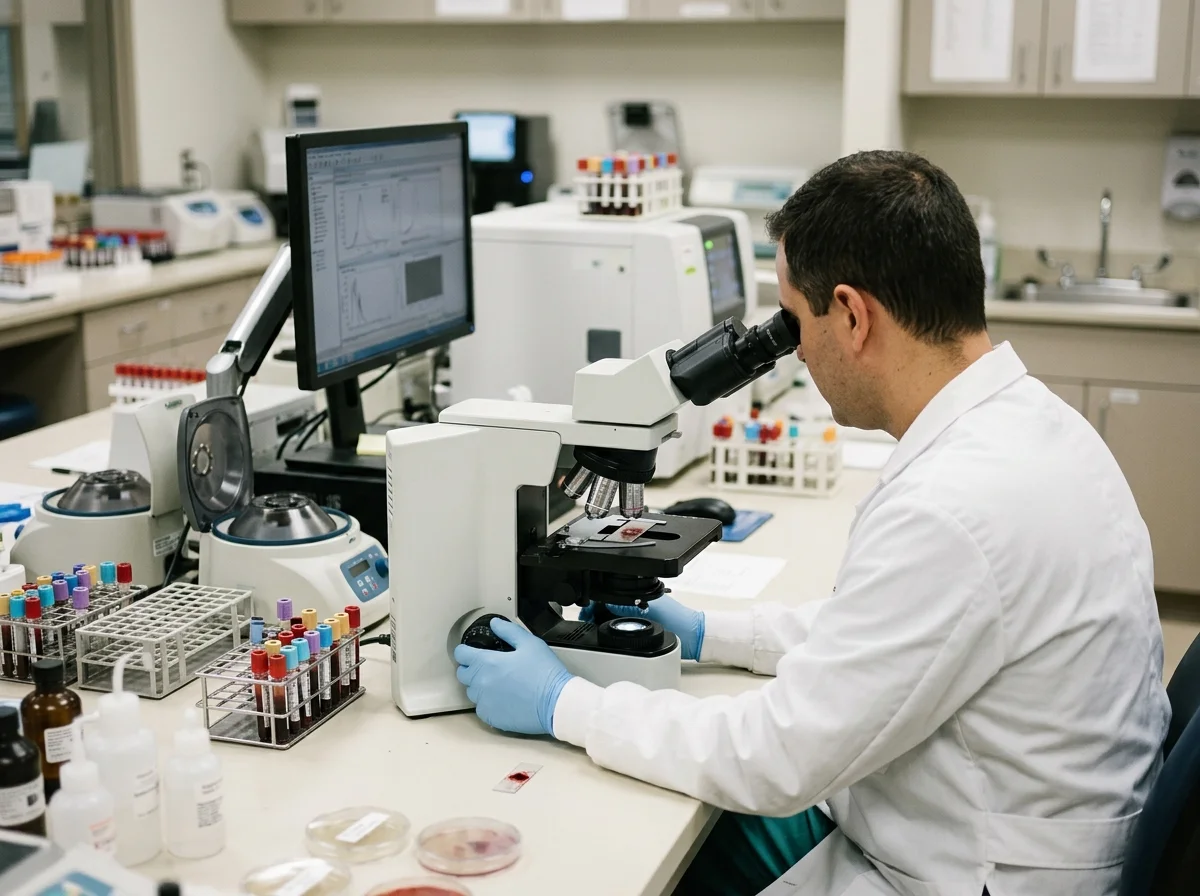
Yes. Hospital laboratories are one of the largest employers of laboratory technicians and technologists, and it is a common destination for graduates of this qualification. In the UK, healthcare science support workers in NHS laboratories are paid on the Agenda for Change scale, starting around Band 2 and progressing to Band 3 with experience. In hospital settings, the work usually involves processing patient samples such as blood, tissue and swabs, running diagnostic tests, and supporting clinical scientists and pathologists rather than treating patients directly. Some roles sit under separate qualifications such as biomedical or medical laboratory science, so it is worth checking whether a specific hospital post asks for that route instead of a general science laboratory technology background.
Science Laboratory Technology Jobs: What Roles Are Available?
The job titles that follow from this qualification vary by country and sector, but common entry points include:
- Laboratory technician
- Laboratory assistant
- Quality control technician
- Research technician
- Microbiology technician
- Chemistry technician
- Environmental testing technician
With experience, progression often leads to senior technician, laboratory supervisor, quality assurance manager or, with further study, into scientist or technologist grades. In the UK, laboratory technicians typically work as part of a team alongside scientists and other technicians, and with experience may go on to supervise lab support workers or junior technicians.
Demand for the role has stayed broadly stable rather than booming. UK government careers data projects around 2.1% growth in laboratory technician jobs by 2029, while in the United States the Bureau of Labor Statistics reports roughly 69,620 people employed nationally in the closest matching biological technician occupation, based on its 2025 wage survey.
Science Laboratory Technology Salary: UK and US Figures
Pay depends heavily on sector, location and experience, so treat the following as a realistic range rather than a fixed figure.
UK Salary
UK government careers guidance puts laboratory technician salaries at roughly £21,000 to £30,000 a year, with the average UK salary reported by the Office for National Statistics at £37,430 in 2024. Independent salary survey data shows a wider spread, with 80% of laboratory technicians in the UK earning between roughly £14,000 and £34,000 gross annually, reflecting the difference between part-time, entry-level and senior positions.
Sector matters too. Under the UK’s Skilled Worker visa rules, laboratory technician roles fall under SOC code 3111, with a going rate of £33,400 a year, and most laboratory technicians nationally earn between roughly £25,000 and £33,800 in basic pay according to 2025 wage data. NHS pay scales sit lower at entry level: healthcare science support roles in NHS laboratories start around £26,658 to £28,947 a year at Band 2, rising to around £29,061 to £31,364 at Band 3.
US Salary
The closest matching US occupation tracked by the Bureau of Labor Statistics is Biological Technicians (SOC 19-4021). The median annual salary for this role in the 2025 BLS data is $57,510, with a typical range running from around $40,330 at entry level up to $71,520 at the 75th percentile, and top earners reaching close to $84,940. Pay varies considerably by city and industry: Los Angeles reports a median of $66,610, Boston sits around $61,610, while Dallas comes in lower, at around $45,750, reflecting cost of living and local demand.
Science Laboratory Technology Courses and Degrees
There are two broad routes into the field: a diploma or associate degree focused purely on applied lab skills, or a full undergraduate degree in a related science subject.
Diploma and Certificate Routes

These are typically two to three years long, delivered at polytechnics, technical colleges and community colleges, and are built around hands-on lab time rather than theoretical depth. A typical programme description frames the qualification as preparation for work as a laboratory technologist in an industrial, government or commercial laboratory, emphasising the application of standard and specialised laboratory techniques across scientific disciplines so students gain practical, job-ready experience. Many diploma programmes also include a work placement or co-op component, alternating classroom study with paid employment in a real laboratory.
Degree Routes
A full science degree (in chemistry, biology, biomedical science or a related subject) takes longer, usually three to four years, and opens the door to research-focused or more senior technical roles, as well as further study at postgraduate level. UK careers guidance notes that laboratory technicians commonly enter the profession through a foundation degree, higher national diploma, or full degree in a relevant science subject.
A Real Example: Red River College’s Science Laboratory Technology Programme
Red River College Polytechnic in Winnipeg, Canada runs one of the most established diploma programmes under this exact name, and it is a useful reference point for what a typical curriculum looks like anywhere in the world. The programme is a full-time, two-year diploma delivered mainly in person, designed to equip students with versatile lab skills in biology and chemistry for a range of scientific and technical roles, with work-integrated learning through co-op placements connecting students to industry partners. Students complete a common first year covering chemistry, microbiology, instrumentation, quality systems and communications, before choosing a second-year specialisation in cell and microbiology, chemistry and quality analyst, or quality assurance.
Admission typically requires Grade 12 level maths (precalculus or applied), two science subjects at the same level (chemistry is strongly recommended), and Grade 12 English. Graduates commonly go on to roles in chemical analysis, research, quality assurance, pharmaceuticals and biotechnology, often securing entry-level positions through the connections made during co-op placements.
Science Laboratory Technology Requirements
Entry requirements vary by country and institution, but most programmes ask for a broadly similar academic profile:
- School-level science subjects: chemistry is almost always recommended or required, alongside biology or physics
- Maths: usually pre-calculus or an equivalent applied maths qualification
- English or the language of instruction: to a standard secondary school pass
- No prior lab experience is usually necessary, though some programmes give preference to applicants with relevant work or volunteer experience
Beyond academic entry requirements, employers and colleges generally expect:
- Attention to detail and a methodical approach to following procedures
- Comfort working with chemicals, biological samples and specialised equipment
- Basic IT literacy for recording and analysing data
- An understanding of, or willingness to learn, health and safety regulations
- The ability to work as part of a team, since most lab environments involve close collaboration with scientists and other technicians
Is Science Laboratory Technology a Good Career Choice?
It suits people who enjoy hands-on, methodical work and want a faster, more direct route into a scientific working environment than a full research degree provides. The trade-off is that entry-level pay in both the UK and the US sits below the wider average wage in each country, and the ceiling on progression without further study is real, particularly in the UK where the gap between entry-level and senior technician pay is narrow.
That said, the breadth of sectors that hire for this skill set, from hospitals and pharmaceutical companies to environmental agencies and food testing labs, means the qualification travels well. A graduate is rarely tied to one industry, and co-op or placement-based programmes make it one of the more employable technical qualifications for anyone who wants to work in science without committing to a lengthy academic research path.
Frequently Asked Questions
Is science laboratory technology the same as medical laboratory science?
No, though the two overlap. Science laboratory technology is a broad, applied qualification that covers chemistry, biology and general lab technique across many industries. Medical laboratory science (sometimes called biomedical science) is a narrower, clinically focused qualification aimed specifically at diagnostic work in hospital and pathology settings, and it usually carries stricter regulatory or licensing requirements depending on the country. Someone with a science laboratory technology background can work in a hospital lab, but a dedicated clinical or diagnostic role will often specifically ask for the medical laboratory science route instead.
Do you need a degree to become a lab technician?
Not always. Many entry-level lab technician roles accept a diploma, foundation degree or higher national diploma rather than a full bachelor’s degree, particularly in industrial, quality assurance or general testing labs. A full degree tends to matter more for research-heavy positions, senior technologist roles, or where a specific employer or country’s regulations require it. In practice, the deciding factor is usually the sector rather than the job title itself.
Is science laboratory technology a hard course to study?
It is demanding in a practical sense rather than a purely theoretical one. The workload leans on precision, repetition and safety discipline rather than heavy mathematics or abstract theory, so students who prefer hands-on, methodical work often find it more manageable than a pure science degree. That said, the science content (chemistry and biology fundamentals) still needs to be understood properly, since mistakes in a lab setting have real consequences.
Can you become a scientist after studying science laboratory technology?
It can be a stepping stone, but it is not a direct route on its own. A science laboratory technology diploma builds strong practical skills that make further study easier, and some graduates go on to complete a full science degree afterwards, sometimes with credit transfer depending on the institution. Without that additional study, the qualification typically leads to technician or technologist roles rather than positions titled “scientist,” which usually require a full undergraduate or postgraduate science qualification.
What’s the difference between a lab technician and a lab technologist?
The terms are often used loosely, but where a distinction is drawn, a technician typically follows established procedures and supports the work of scientists, while a technologist has a broader, more advanced skill set and may take on more independent testing, troubleshooting or method development. In practice, the exact split varies by employer and country, and the two titles are frequently used interchangeably for very similar day-to-day work.
Is science laboratory technology in demand as a career?
Demand is steady rather than fast-growing in most sectors, sitting close to average job growth rather than a boom area. Because the skill set applies across so many industries, from healthcare and pharmaceuticals to environmental testing and food production, graduates are not dependent on a single sector staying strong, which gives the qualification more resilience than a narrower one even if headline growth figures look modest.