Reviewed and last updated on July 29, 2026 by Awais Ahmed, Founder & Editor-in-Chief, Urban Scope News.
Light roast coffee is coffee that has been roasted for a shorter time than medium or dark roasts, generally stopped during or shortly after “first crack”, the point where the beans make an audible popping sound as trapped moisture and gases escape. First crack commonly occurs at a measured bean temperature of roughly 196 to 205°C, although the exact reading varies between roasters, machines and temperature probes. Stopping the roast here keeps origin-linked sensory characteristics, such as acidity and fruit or floral notes, more noticeable than in darker roasts.
Light roast has become popular with specialty coffee drinkers who want to taste the specific characteristics of where a coffee was grown, rather than the flavour created by the roasting process itself. This guide explains what light roast coffee actually is, how it compares with medium and dark roasts, what it is good for, and clears up some common myths about caffeine and health.
What Is a Light Roast Coffee, Exactly?
Light roast coffee beans are roasted only until shortly after first crack, at a measured temperature of roughly 196 to 205°C. Roasting stops here, before the beans reach the darker, oilier stage associated with medium and dark roasts.
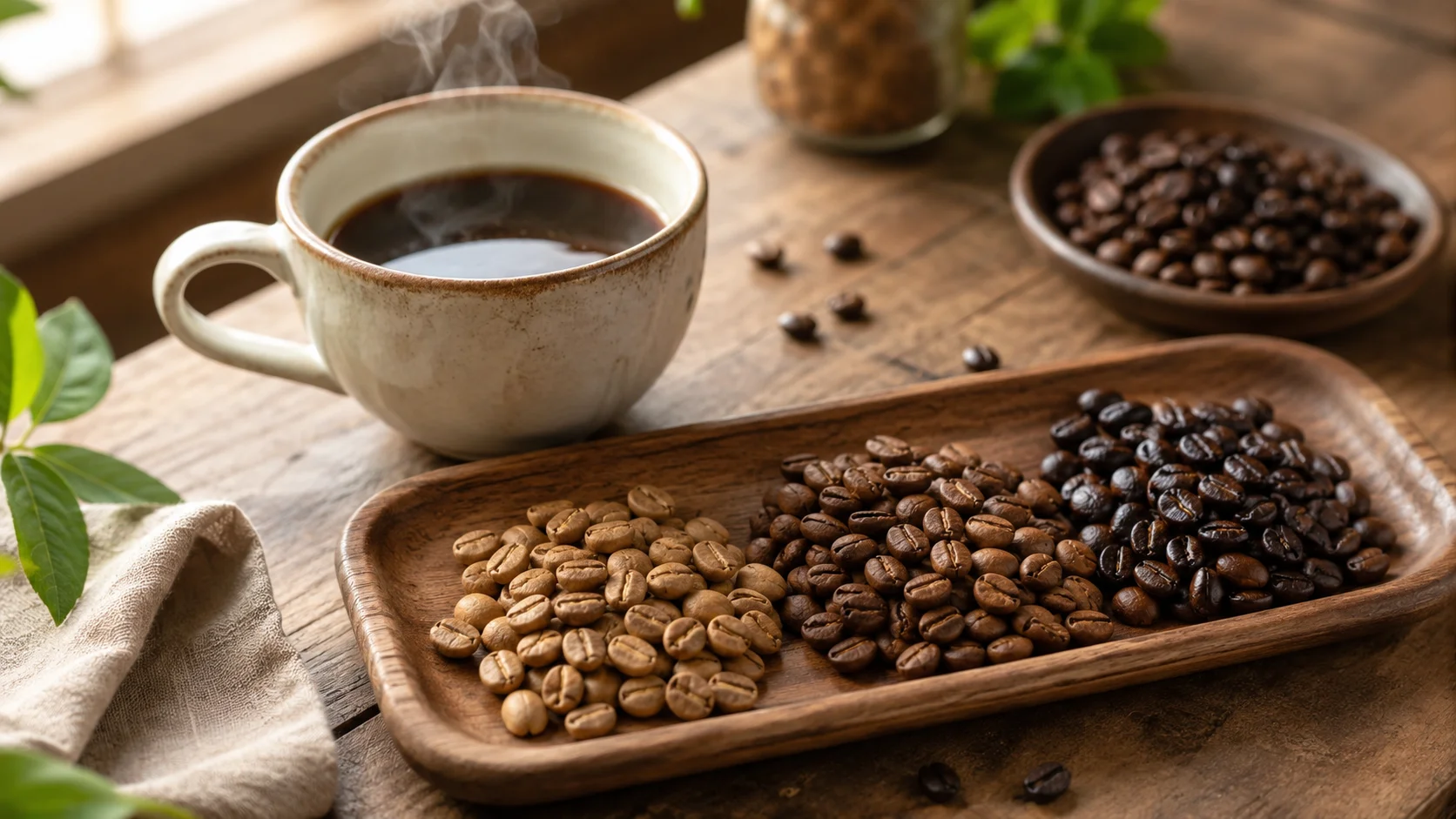
Because the roasting process is shorter, light roast beans retain more of their original density and keep origin-linked sensory characteristics, such as acidity, sweetness or fruit notes, more noticeable, depending on where the coffee was grown. The beans themselves look light tan to brown, feel harder and denser than darker roasts, and have a dry surface with no visible oil.
What Is a Light Roast Coffee Good For?
Light roast coffee is well suited to people who want to taste the specific character of a coffee’s origin, such as its acidity, sweetness or fruit notes, rather than the smoky or bitter notes created by heavier roasting. It works particularly well for:
- Pour-over and filter brewing, where slower extraction highlights subtle flavour notes
- Single-origin coffees, since light roasting keeps the characteristics of the specific growing region more noticeable
- Drinkers who prefer a brighter, more acidic cup rather than a heavy, bittersweet one
Light roasts can also be used for espresso, although their denser structure and lower solubility may require a finer grind, higher brewing temperature or longer brew ratio to achieve balanced extraction. This is a brewing adjustment rather than a machine limitation, and light-roast espresso is common in specialty coffee.
What Are the 4 Types of Coffee Roast?
One common informal framework divides coffee into four broad categories, based on roasting time, temperature and the resulting colour of the bean. These terms are not standardised across the industry, and different roasters may label similar roast colours differently, but this grouping is widely used by consumer-facing brands:
- Light roast: Light brown, no oil on the surface, roasted to shortly after first crack (roughly 196 to 205°C). Keeps origin flavour and acidity most noticeable.
- Medium roast: Medium brown, still little to no oil on the surface, roasted a little further than light. Balances origin flavour with some roast-driven sweetness and body.
- Medium-dark roast: Darker brown with a slightly oily surface, roasted closer to second crack. Fuller body, less acidity, more caramelised sweetness.
- Dark roast: Dark brown to near-black, visibly oily surface, roasted at or beyond second crack. Bold, bittersweet, smoky flavour, with roast flavour more dominant than origin character.
Commercial products are often grouped more simply as just light, medium and dark, so you may see either system depending on the retailer or roaster.
What Is Medium Roast Coffee?
Medium roast coffee is roasted a little further than light roast. It balances some of the brighter, acidic notes of light roast with the added sweetness and fuller body that comes from a longer roast. Medium roast is often described as a balanced, versatile option, and it is widely available in supermarkets and cafés.
What Is Dark Roast Coffee?
Dark roast coffee is roasted to a higher temperature, at or beyond second crack. The extended heat breaks down more of the bean’s natural sugars and acids, producing a bold, smoky, sometimes bittersweet flavour with a heavier body. The surface of dark roast beans is visibly oily, because oils inside the bean are drawn out under prolonged heat. Roast-driven flavour becomes more dominant than origin-specific notes.
Is Dark Roast Coffee Bad for You?
Dark roast is often assumed to be a less healthy choice, but the evidence does not support that assumption in any straightforward way. One common concern is acrylamide, a compound formed during roasting and classified as a probable carcinogen based on animal studies. Acrylamide tends to reach higher levels in lighter roast stages and can decline as roasting continues, so several studies have found higher acrylamide concentrations in lighter roasts rather than darker ones, though values vary by bean and roasting process. A lower acrylamide reading should not be read as automatically “healthier”, since other compounds and total consumption still matter.
On coffee and cancer more broadly, the World Health Organization’s International Agency for Research on Cancer (IARC) reviewed more than 1,000 studies in 2016 and classified coffee drinking itself as Group 3, “not classifiable as to its carcinogenicity to humans.” Separately, IARC classified any beverage consumed above 65°C as Group 2A, “probably carcinogenic to the human oesophagus”, a finding about beverage temperature in general rather than coffee specifically, and coffee is typically drunk below that temperature.
Furan is another compound worth knowing about: its concentration in coffee generally increases with darker roasting, though exposure also depends on grinding, storage and brewing, since furan is volatile. This does not establish that dark roast is harmful or less healthy overall, only that it is a compound roast level can influence.
Coffee may cause digestive discomfort or reflux in some people, but the evidence does not clearly show that dark roast is more irritating than other roast levels. Limited human research has actually suggested that some dark roasts may stimulate less gastric acid secretion than medium roast. Individual tolerance varies and is not determined by roast level alone.
Light Roast vs Dark Roast Caffeine Content
This is one of the most misunderstood topics in coffee. The common assumption is that dark roast, with its bolder flavour, must contain more caffeine. Caffeine is heat-stable and does not break down significantly at typical roasting temperatures, so the general message that a darker flavour does not automatically mean more caffeine is correct.
However, the details are less clear-cut than a simple rule. Roasting changes bean mass, density, porosity and extractability, and studies have produced different results depending on how caffeine is measured. Some brewing research has found that dark roasts generally produce less caffeine under identical brewing conditions, but can produce higher caffeine concentrations when compared at identical extraction yields. Other studies have found no significant caffeine difference between light, medium and dark samples at all.
Roast level alone is a poor predictor of caffeine content. Light and dark roasts are often similar when the same mass of coffee is used, but findings vary because roasting also changes density and extraction behaviour. A volume measure, such as a scoop, may hold more light-roast bean material because the beans are denser, but that does not reliably guarantee a more caffeinated cup. Coffee species, dose, grind, brewing method and beverage size matter more than roast level on its own.
Caffeine Difference Between Light and Medium Roast Coffee
The same principle applies between light and medium roast. Any difference tends to be small and is better described as a tendency than a universal rule, since roasting alters density and extraction in ways that do not always translate predictably into the finished cup. In practical terms, the difference between light and medium roast caffeine is unlikely to be noticeable without precise, controlled measurement, and factors like bean species (Arabica versus Robusta), dose and brewing method have a far bigger influence on your final caffeine intake than roast level does.
Light Roast Coffee Beans: What to Look For
When buying light roast coffee beans, look for a light tan to medium brown colour with a matte, dry surface and no visible oil. The beans should feel noticeably harder and denser than medium or dark roast beans of the same size.
Freshness matters for every roast level, not just light roast. Buy manageable quantities, keep the beans sealed away from heat, moisture and light, and grind them shortly before brewing to get the most out of any roast.
Frequently Asked Questions
What is a light roast coffee good for? Light roast suits drinkers who want to taste a coffee’s origin character, such as its acidity, sweetness or fruit notes, and it works particularly well with pour-over and filter brewing methods.
Is light roast coffee stronger than dark roast? Not reliably in terms of caffeine, findings on this vary between studies. Light roast can taste less “strong” than dark roast because it has a brighter, more acidic flavour rather than the bold, bittersweet taste associated with heavier roasting.
Does dark roast coffee have less caffeine than light roast? It depends on how it is measured and brewed. Some studies find dark roast produces less caffeine under identical brewing conditions, others find no significant difference between roast levels, so roast level alone should not be treated as a reliable caffeine indicator.
Is dark roast coffee worse for your health than light roast? Not based on current evidence. Acrylamide, one of the main health concerns raised about coffee, has generally been found at higher levels in lighter roasts rather than dark roasts, and IARC classifies coffee drinking itself as not classifiable as to carcinogenicity.
What are the main types of coffee roast? One common informal framework describes light, medium, medium-dark an`d dark roast, distinguished by roasting time, bean colour, surface oil and flavour profile, though these categories are not standardised across the industry.