Reviewed and last updated on September 7, 2026 by Awais Ahmed, Founder & Editor-in-Chief, Urban Scope News.
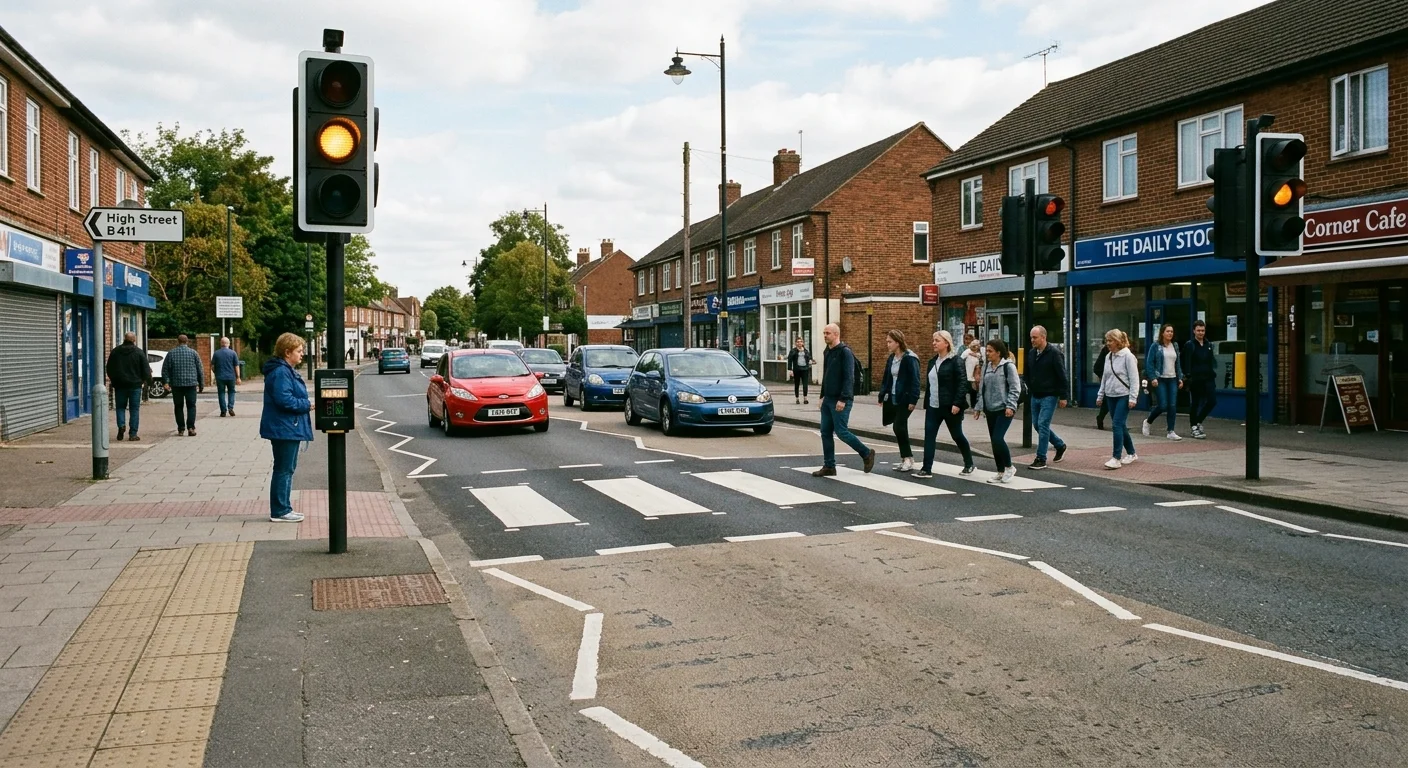
A puffin crossing is a sensor-controlled pedestrian crossing found across the UK, identifiable by its near-side pedestrian signals and its use of detectors rather than a fixed flashing phase. A pedestrian presses a button to request a crossing. Traffic stops at red, and a steady green figure tells pedestrians to cross. Unlike a pelican crossing, there is no flashing green figure and no flashing amber. Instead, built-in sensors track whether people are still on the crossing and adjust the timing accordingly.
What is a puffin crossing?
The puffin crossing meaning is built into the crossing’s design rather than into a straightforward acronym expansion the way pelican’s is. The name follows the naming style set by pelican crossings, and is commonly expanded online as Pedestrian User-Friendly Intelligent, reflecting the crossing’s use of pedestrian detection technology. This expansion is widely repeated but not something government sources formally confirm, so it’s worth treating as the accepted shorthand rather than an official definition.
The first puffin crossings were trialled in the UK in the early 1990s, with wider national adoption following the Zebra, Pelican and Puffin Pedestrian Crossings Regulations and General Directions 1997.
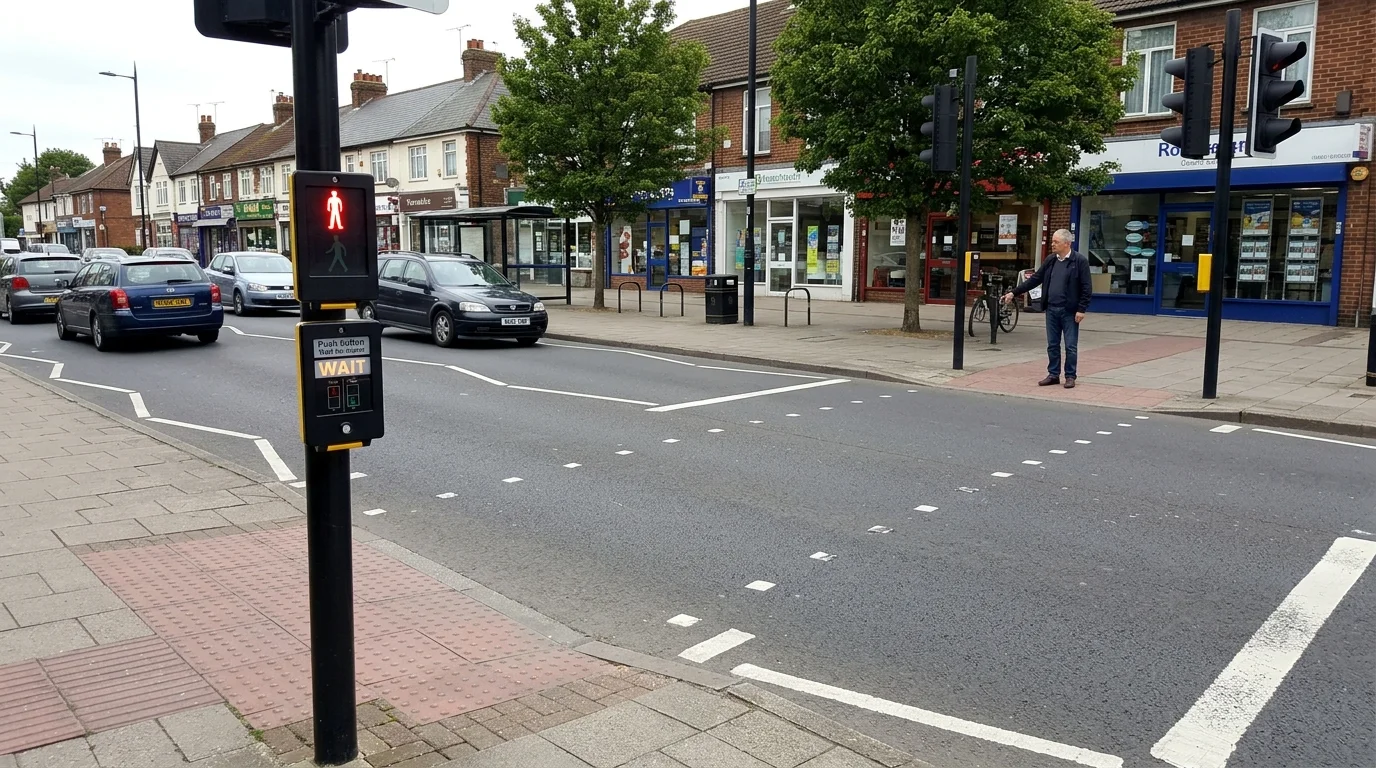
The clearest identifying feature is where the pedestrian signal sits. On a puffin crossing, the red and green figures are mounted above the push button, on the same side of the road as the person waiting to cross, rather than on a pole facing them from across the street. This near-side placement lets pedestrians watch the signal and the approaching traffic in the same glance, and it also helps people who would otherwise struggle to see a signal mounted far away across the carriageway.
How does a puffin crossing work?
Using a puffin crossing starts the same way as any other push-button crossing: press the button to register a request. From there, the process is different from a pelican crossing in one key respect. A puffin crossing uses two types of sensor rather than a fixed light sequence to manage the pedestrian phase.
The first is a kerbside detector, positioned to watch the pavement where someone pressed the button. If that person changes their mind and walks off before the lights change, the kerbside detector can cancel the request automatically, which keeps traffic moving rather than stopping vehicles for someone who is no longer there.
The second is an on-crossing detector, which watches the road itself once the green figure has shown. If someone is still partway across when the signal would normally change, this detector can hold the red light for traffic a little longer, extending the crossing time until the road is clear. This is the main practical advantage a puffin crossing has over a pelican crossing: the timing responds to the person actually using it, rather than running on a preset interval regardless of how quickly they walk.
What is the puffin crossing light sequence?
For drivers, the sequence looks similar to an ordinary traffic light, without the flashing amber phase a pelican crossing uses:
| Signal | What it means |
|---|---|
| Green | You may proceed if the road and crossing are clear. |
| Steady amber | Stop unless you have already crossed the stop line or are so close that stopping could cause a collision. This phase lasts around three seconds. |
| Red | You must stop behind the stop line. Sensors may extend this phase if pedestrians are still crossing. |
| Green | Traffic movement resumes once the crossing is clear, or once the sensors register no pedestrian is left in the crossing area. |
This sequence answers a common theory test question: what colour follows green at a puffin crossing? The answer is steady amber, exactly as at an ordinary set of traffic lights, before the signal reaches red.
For pedestrians, the sequence is simpler again. A red figure means wait. A steady green figure means check that traffic has stopped and then cross. There is no flashing green figure phase at a puffin crossing, which is the detail most theory test questions are built around, since it is the single biggest visible difference from a pelican crossing.
Puffin crossing lights and what they mean
Because puffin crossings do not use a flashing amber or flashing green phase, the lights themselves carry a slightly different meaning from a pelican crossing at each stage:
- Red figure showing: wait on the kerb. Do not begin crossing.
- Steady green figure showing: check that traffic has actually stopped, then cross with care.
- Before the green figure appears: the crossing system may still be processing your request through its detection sensors, particularly on a crossing that has just been used.
- No flashing phase at any point: if the green figure disappears, it has simply gone back to red. There is no in-between warning stage the way there is at a pelican crossing.
Puffin vs pelican crossing, in brief
A full pelican vs puffin comparison sits on its own page in this cluster, but the headline difference worth stating here is straightforward. A pelican crossing uses far-side pedestrian signals, a flashing green figure, and flashing amber for traffic. A puffin crossing uses near-side pedestrian signals, no flashing phase at all, and sensor-based timing instead. The Highway Code sets this out directly: puffin crossings differ from pelican crossings because the red and green figures are above the control box on the pedestrian’s own side of the road, and there is no flashing green figure phase.
What the Highway Code says
Puffin crossings are covered specifically in the Highway Code’s rules for pedestrians. The core points are:
- Press the button and wait for the green figure to show, rather than watching for any flashing signal.
- If the road is congested, traffic on your side may stop even though the lights are green, since traffic further along may still be moving. Press the button and wait for the crossing signal rather than assuming stopped traffic means it is safe to cross.
- A staggered puffin crossing, where the two halves either side of a central island are offset rather than lined up, counts as two separate crossings. Pedestrians should press the button again on the central island and wait for a fresh green figure before crossing the second half.
- Some crossings include a bleeping sound or voice signal for blind or partially sighted pedestrians, and a tactile signal for deafblind pedestrians, in the same way pelican crossings do.
Can cyclists use a puffin crossing?
Puffin crossings are built for pedestrians only, in the same way pelican crossings are. Cyclists should dismount and wheel their bicycle across rather than ride through, even during the green pedestrian phase. A toucan crossing is the version designed specifically so cyclists can ride across alongside pedestrians, using a shared green signal for both.
Where are puffin crossings used in the UK?
Puffin crossings are now the most common type of new pedestrian signal crossing across Great Britain, and turn up wherever a signal-controlled crossing is needed: busy urban roads, town and city centres, school approaches, and junction crossings where a standalone signal is more practical than incorporating pedestrians into a junction’s main traffic phase. Because installation decisions sit with individual local authorities, the exact mix of pelican, puffin and toucan crossings in any one area varies, but new installations are overwhelmingly puffin rather than pelican.
Why puffin crossings became the standard choice
Puffin crossings are now the default choice for new signal-controlled pedestrian crossings across Great Britain, replacing pelican crossings for most new installations since 2016. The reasoning behind the switch comes down to the two practical gaps a pelican crossing has that a puffin crossing does not: a pelican runs on a fixed timer regardless of how quickly someone can cross, and it asks pedestrians to look at a signal on the far side of the road rather than the side they are standing on. A 2005 study commissioned by the Department for Transport found puffin crossings involved fewer pedestrian accidents and fewer accidents involving cars than pelican crossings.
None of this means puffin crossings are free of criticism. Some pedestrians find the lack of a flashing warning phase less intuitive at first, since a pelican crossing gives a clear signal that time is running out, where a puffin crossing simply reverts to red without warning once its sensors judge the crossing is clear. Transport for London cited exactly this concern in 2014 when it stopped installing new puffin crossings, noting that pedestrians had reported disliking the uncertainty of not knowing whether the crossing signal was still active once they had started to cross. In practice, most people adjust to the design quickly, and the sensor-based timing tends to reduce unnecessary waiting for both pedestrians and drivers compared with a fixed sequence.