
Reviewed and last updated on November 22, 2026 by Awais Ahmed, Founder & Editor-in-Chief, Urban Scope News.
MMSBRE has no confirmed meaning, and nothing shows that it is a recognised technology, product or standard. Most websites expand it as Multi-Media Streaming and Broadcast Relay Environment. Other pages use the same six letters for a business framework or an artificial intelligence method, and none of them names a developer, a company or a specification behind the term.
That mismatch is the real story. A search returns plenty of confident explanations, but they disagree with each other and rarely show where their definitions came from. This guide sets out what the competing versions claim, what can actually be checked and how to handle a label like this when you meet it.
Three Different Meanings, None of Them Confirmed
Pages that rank for the term fall into three camps. The largest camp reads MMSBRE as a streaming system, usually written as Multi-Media Streaming and Broadcast Relay Environment. Some pages leave out the word and, which shows how loosely the wording gets copied between sites. In this version, the term describes the equipment and software that take a video or audio feed, process it and relay it to viewers.
The second camp treats it as a business idea. These pages expand the letters as Modular Multi-Sided Business Resource Ecosystem and describe a flexible setup for sharing tools, data and workflows between teams or partners. The third camp is much smaller. A few pages say the letters stand for Multi-Modal Sequential Bayesian Regression Estimator, a phrase that belongs to artificial intelligence and has no link to either of the other readings.
Some articles even blend two camps into a single explanation. That is hard to square with a term that one organisation coined. When a name has a clear origin, its expansion stays fixed. When different writers supply different words for the same six letters, the likelier explanation is that each one filled the gap with whatever suited their subject.
What a Search for an Official Source Actually Finds
A genuine technical term usually leaves a trail. Protocols appear in specifications, products have vendor pages, and research ideas turn up in journals or conference programmes. Searches for the exact term MMSBRE found none of these. There was no dictionary entry, no standards document, no named developer and no company selling a product under the name.
What exists instead is a crowd of explainer articles, most of them published during 2026 on small publishing sites. They tend to repeat each other’s wording, cite no primary source for the name and describe it in general terms that could fit almost any system. Several of those pages admit as much. They say the expansion is not officially verified, and at least one goes further and calls the term a manufactured keyword.
This does not prove that nobody has ever used MMSBRE. Teams sometimes coin private abbreviations for projects that never go public. A private label is still different from an established technology, and nothing visible suggests that even a private version exists here.
Why the Streaming Version Sounds So Convincing
The streaming reading is persuasive because it describes things that genuinely exist. A video leaves a camera or a file. An encoder compresses it into several quality levels. Servers store and relay those versions, and a player on the viewer’s device picks the one its connection can handle. Content delivery networks keep copies on servers closer to the audience, so a large crowd does not overwhelm one machine.
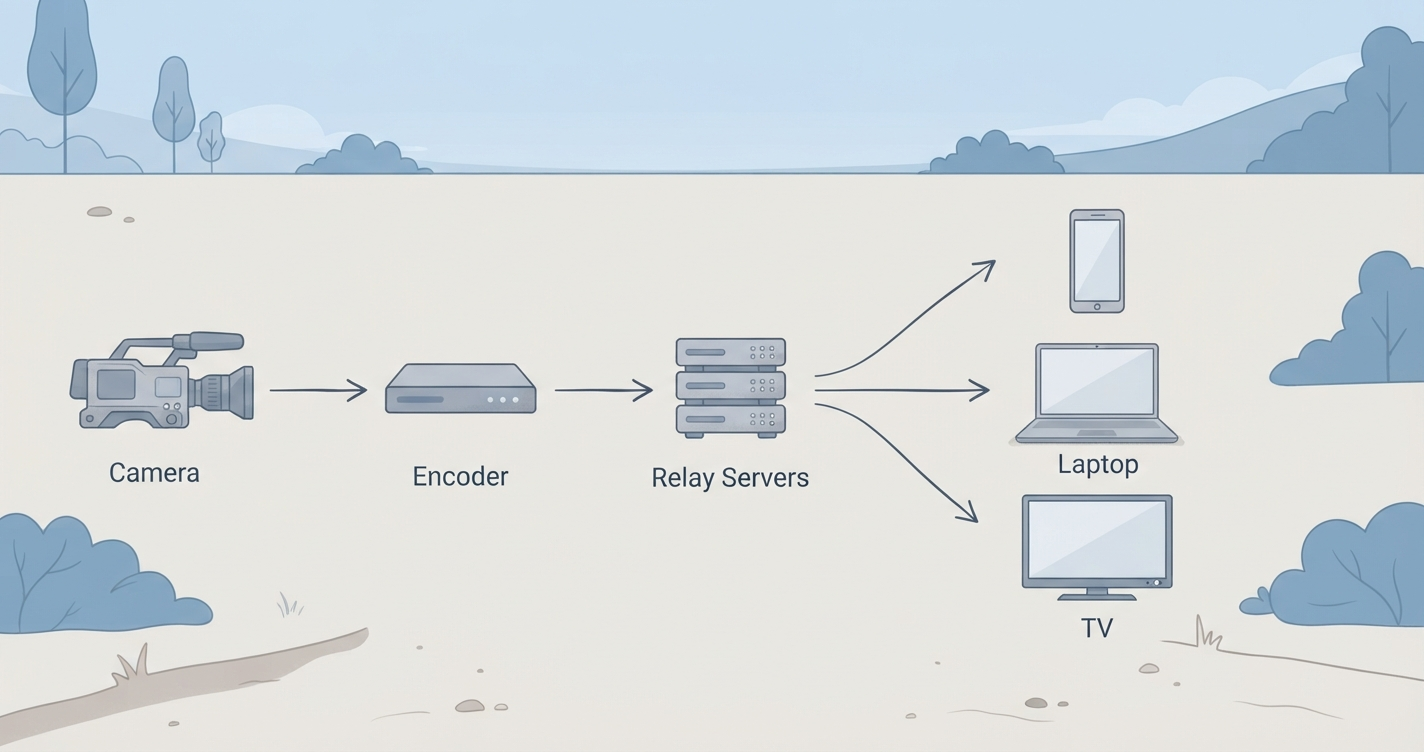
Each step already has a documented name. HTTP Live Streaming, usually shortened to HLS, divides media into small segments and lets the player switch between quality levels as network conditions change. Its mechanics are set out in the published specification for HTTP Live Streaming, which is an informational document and not an internet standard. That distinction is worth remembering whenever a technology is called official. MPEG-DASH tackles the same problem with a different format. Adaptive bitrate streaming, multistreaming and content delivery networks are all terms that engineers teach and document.
The same chain ends in ordinary living rooms every day, whether someone uses built-in apps or a smart TV box that adds streaming apps to an older television. None of it needs the name MMSBRE to work.
Here is the key point. Explaining how streaming works does not show that MMSBRE names any of it. An article can describe encoding and relay servers accurately and still attach an invented label to them. Readers who want reliable detail on how video reaches a screen will find better sources by searching the established terms.
The MMS Overlap That Causes Confusion
The first three letters point many readers towards a different and genuine term. MMS is the usual abbreviation for Multimedia Messaging Service. The National Institute of Standards and Technology lists it in its glossary entry for the messaging standard as an accepted way to send messages that combine text, graphics, photographs, audio and video clips. MMS also stands for Microsoft Media Server, an older streaming protocol that used addresses beginning with mms://.
Both are real, and both involve multimedia. That overlap may be why the streaming expansion feels believable. Shared letters are not shared meaning, though. Nothing shows that MMSBRE extends either one, and the final three letters are the very part that nobody explains consistently.
How a Term Like This Gains Momentum
Nobody can say from the outside how MMSBRE began. What is visible is how it spreads. Curious readers type an unfamiliar word into a search engine. Publishers notice the interest and write an explainer. Those explainers borrow from one another, and autocomplete suggestions nudge more people to search the same word. Each step makes the term look more established than the one before.
Search visibility is not independent confirmation. Ten pages repeating one expansion do not amount to ten sources agreeing. They may amount to one claim copied ten times. A more useful test is whether any source outside that circle, such as a standards body, a vendor or a published paper, uses the term in the same way.
Readers who follow unfamiliar online words will recognise the pattern. A similar word that collected many conflicting explanations followed much the same route, and the same questions apply to both.
What to Do If You Meet MMSBRE in Something Real
Context settles most cases. If the term appears in a supplier’s proposal, a software listing or a colleague’s notes, ask the person who used it to define it in plain words and point to the documentation. A genuine system has a purpose, an owner and technical details that fit on one page. A vague answer is informative on its own.
Check the date and authorship as well. A recent article is not the original source, and an explanation from an unnamed editorial team deserves less weight than documentation from a named developer. Then look for confirmation from somewhere that has no stake in repeating the claim.

Businesses should also avoid building procurement, contracts or technical plans around an acronym nobody can define. If a supplier insists on using it, ask them to name the underlying technologies instead, such as the streaming protocol, the delivery network and the monitoring tools. Those names can be compared, priced and verified. The acronym cannot.
The Short Answer
MMSBRE is best described as an unofficial label with several competing meanings and no confirmed source. The most common reading, a multimedia streaming and broadcast relay environment, borrows ideas from real streaming technology but does not show that the name itself refers to anything specific. Until a named developer, a specification or a credible independent source defines it, treat every explanation, this one included, as a summary of claims that still need checking.